
Why Ann Arbor Condos Are Experiencing Price Reductions this Spring
Price Reductions for Ann Arbor Condos

If you’re following the Ann Arbor housing market, you’ve likely noticed a curious trend this Spring—price reductions on condos are becoming more common. For homebuyers and sellers alike, this shift raises a lot of questions. Why are prices being lowered? What does it say about the market? And most importantly, how should you respond, whether you’re buying or selling?
This blog will break down the key reasons behind these price adjustments, the economic factors at play, and what this market trend means for both buyers and sellers. We’ll also share tips for navigating these changes.
What’s Causing the Price Drops?
Several factors are driving the recent wave of condo price reductions in Ann Arbor. While changes like this are rarely the result of one issue alone, the following may help explain the bigger picture.
1. Shifting Market Conditions
Over the past year, the real estate market in the U.S. has cooled after a frenzied post-pandemic housing boom. Ann Arbor, like many cities, is experiencing the effects of this market recalibration. Gone are the days when sellers could list their properties at inflated prices and expect competing offers within hours. Today, homes—including condos—are sitting on the market longer, forcing sellers to reconsider their pricing strategies.
2. Economic Influences
National and local economic factors also play a critical role. As of June 2025, interest rates remain elevated compared to their historical lows. Higher mortgage rates directly impact affordability for buyers. With borrowing costs rising, many prospective buyers are scaling down their budgets or opting to rent instead. This ultimately reduces demand for condos, putting downward pressure on prices.
Additionally, uncertainties in the broader economy, such as concerns about inflation or possible recessionary trends, may be making buyers more cautious. Economic uncertainty often translates to softer real estate markets.
3. Increase in Inventory
Another part of the equation is an increase in condo inventory. Over the last few years, Ann Arbor has seen a rise in new condo developments catering to its growing population of students, professionals, and retirees. In May 2025, Ann Arbor saw a 28% increase in listings compared with May 2024. While this increase in supply is great for buyers, it means sellers now face more competition. When buyers have more options, sellers must be willing to negotiate or lower their asking prices to make their listings stand out.
4. Potential Overpricing
Some sellers in Ann Arbor may have initially priced their condos too high. This might be due to lingering expectations from the seller-friendly market of recent years or a misunderstanding of current conditions. When a home sits on the market without generating enough interest, sellers often opt for price reductions to attract a new buyer pool, get offers, and avoid prolonged market exposure.
The Impact on Buyers and Sellers
Price reductions affect buyers and sellers in different ways, and understanding these impacts can help you make informed decisions.
For Buyers
Price reductions present an opportunity, especially for those who have been struggling to break into the competitive housing market. Here’s what buyers can expect:
- More Negotiating Power: Buyers may find they have an edge when making offers, as sellers are more motivated to close deals.
- Wider Choices: Since inventory levels are higher, buyers can take their time to explore more options and make decisions that align with both their preferences and budgets.
- Affordability Considerations: Although sellers are reducing prices, higher mortgage rates may still make monthly payments a challenge. Ensure you run the numbers carefully before committing.
For Sellers
If you’re selling your condo in Ann Arbor, this environment can feel more challenging. However, understanding the reality of today’s market can help you adjust your approach:
- Pricing Strategically: Setting a realistic price from the beginning is critical to attracting buyers. Consider consulting with a local real estate professional who understands current market trends.
- Considering Pre-Listing Improvements: Enhancing your condo’s appeal through small upgrades or staging can help it sell faster, even in a cooling market.
- Being Patient and Flexible: Be prepared for the possibility of longer listing times and the need to negotiate with buyers.
Navigating the Current Market
Whether you’re a prospective buyer or a seller, here are some tips for navigating today’s Ann Arbor condo market:
Advice for Buyers
- Know Your Budget: With changing market conditions and higher mortgage rates, determine what you can comfortably afford before starting your search.
- Be Prepared to Compromise: While inventory is higher, the perfect property may still come at a premium. Know your non-negotiables and be willing to compromise on other aspects.
- Time Your Offers Strategically: Staying informed about price reductions and market dynamics can help you make well-timed offers, potentially securing a great deal.
Advice for Sellers
- Work with a Pro: An experienced real estate agent familiar with Ann Arbor’s unique market can provide pricing strategies that help your condo remain competitive.
- Focus on Presentation: Ensure your condo makes a strong first impression with prospective buyers. This could include staging, professional photos, or hosting open houses.
- Adjust Quickly: If your condo isn’t generating interest after a couple of weeks, reevaluate your strategy. This might mean a price adjustment or additional marketing efforts. Typically, if you’ve had 10-12 showings and no offers, you’re 4-6% over list price, and if you’ve had no showings, you’re 10% over.
Looking Ahead
The Ann Arbor market is undergoing a period of recalibration, which may continue through 2025. While this isn’t ideal for every seller, it’s a necessary part of balancing supply and demand, paving the way for more sustainable market conditions in the long term. If you’re planning to buy or sell a condo, staying informed and adapting to these changes will help you make the most of today’s real estate landscape.
Whether you’re a first-time homebuyer or a seasoned property owner, preparing for these shifts is key. Taking proactive steps now can lead to better opportunities in the months ahead. Contact us today at The Bouma Group, Realtors at 734-761-3060 or info@condohotline.com and let’s get your condo priced correctly to sell!
Buyers, start your Ann Arbor Condo search here!
The 5 Biggest Mistakes Sellers Are Making Right Now
5 Mistakes Sellers Are Making

The housing market is going through a transition. Higher mortgage rates are causing more moderate buyer activity at the same time the supply of condos and homes for sale is growing.
And if you aren’t working with an agent, you may not realize that. Here’s the downside. You can’t adjust your strategy or expectations to today’s market if you’re not informed. And that can lead to a number of costly mistakes.
Here’s a look at some of the most common mistakes sellers are making – and how an agent will help you avoid them when you sell.
1. Overpricing Your Condo or House
Many sellers set their asking price too high and that’s why there’s an uptick in homes with price reductions today. An unrealistic price will deter potential buyers, cause an appraisal issue, or lead to your property sitting on the market longer. An article from the National Association of Realtors (NAR) explains:
“Some sellers are pricing their homes higher than ever just because they can, but this may drive away serious buyers and result in unapproved appraisals . . .”
To avoid falling into this trap, partner with a pro. An agent uses recent sales of similar properties, the condition of your property, local market trends, and so much more to find the price that’ll attract more buyers and open the door for multiple offers and a faster sale.
2. Skipping the Small Stuff

You may try to skip important repairs, thinking you can pass the task on to your buyer. But visible issues (even if they’re small) can turn off potential buyers and result in lower offers or demands for concessions. As Money Talks News says:
“Home shoppers like to turn on lights, flush toilets and run the water. If these basic things don’t work, they may assume you’ve skipped other maintenance. Homes that appear neglected aren’t likely to fetch top price.”
If you want to get your place ready to sell, the best place to turn to for advice is your agent. They’ll be able to do a walk-through with you and point out anything you’ll need to tackle before the photographer comes in.
3. Not Looking at Things Objectively
Buyers today are feeling the pinch of high prices and mortgage rates. With affordability that tight, they may come in with an offer that’s lower than you’d want to see – especially if you didn’t stage, price, or market the house well.
It’s important you don’t take this personally. Getting overly emotional can put the sale at risk. As an article from Ramsey Solutions says:
“Remember, a buyer’s offer is not a reflection of their opinion of your home or your housekeeping abilities. . . The sale of your home is strictly a business transaction. If they start out with a low offer, don’t take it personally and get emotional. Instead, channel that energy toward negotiating. Work with your agent and make a counteroffer.”
4. Being Unwilling To Negotiate
The supply of condos and homes for sale has grown. That means buyers have more options, and with that comes more negotiation power. As a seller, you may see more buyers getting an inspection, requesting repairs, or asking for help with closing costs today. You need to be prepared to have those conversations. As U.S. News Real Estate explains:
“If you’ve received an offer for your house that isn’t quite what you’d hoped it would be, expect to negotiate . . . the only way to come to a successful deal is to make sure the buyer also feels like he or she benefits . . . consider offering to cover some of the buyer’s closing costs or agree to a credit for a minor repair the inspector found.”
An agent will walk you through what levers you may want to pull based on your own goals, budget, and timeframe.
5. Not Using a Real Estate Agent
Notice anything? For each of these mistakes, partnering with an agent helps prevent them from happening in the first place. That makes trying to sell your condo or house without an agent’s help the biggest mistake of all.
Real estate agents have experience and expertise in pricing, marketing, negotiating, and more. That knowledge streamlines the selling process and usually results in drumming up more interest and ultimately can get you a higher final price.

Bottom Line
If you want to avoid these mistakes sellers are making, let’s connect to make sure you’re set up for success. Contact us at The Bouma Group at 734-761-3060 or info@condohotline.com today! We can help you navigate this ever-changing market and personalize a plan for you.
Foreclosures and Bankruptcies Won’t Crash the Housing Market
Foreclosures and Bankruptcies Won’t Crash the Housing Market

If you’ve been following the news recently, you might have seen articles about an increase in foreclosures and bankruptcies. That could make you feel uneasy, especially if you’re thinking about buying or selling a condo or house.
But the truth is, even though the numbers are going up, the data shows the housing market isn’t headed for a crisis.
Foreclosure Activity Rising, but Less Than Headlines Suggest
In recent years, the number of foreclosures has been very low. That’s because, in 2020 and 2021, the forbearance program and other relief options were put in place. Many homeowners were able to stay in their condos or homes during that tough time.
When the moratorium ended, there was an expected rise in foreclosures. But just because they’re up, that doesn’t mean the housing market is in trouble.
To help you see how much things have changed since the housing crash in 2008, check out the graph below using research from ATTOM, a property data provider. It looks at properties with a foreclosure filing going back to 2005 to show that there have been fewer foreclosures since the crash.

As you can see, foreclosure filings are inching back up to pre-pandemic numbers, but they’re still way lower than when the housing market crashed in 2008. Today, the tremendous amount of equity American homeowners have in their homes can help people sell and avoid foreclosure.
The Increase in Bankruptcies Isn’t Dramatic Either
As you can see below, the financial trouble many industries and small businesses felt during the pandemic didn’t cause a dramatic increase in bankruptcies. Still, the number of bankruptcies has gone up slightly since last year, nearly returning to 2021 levels. But that isn’t cause for alarm.

The numbers for 2021 and 2022 were lower than more typical years. That’s in part because the government provided trillions of dollars in aid to individuals and businesses during the pandemic. So, let’s instead focus on the bar for this year and compare it to the bar on the far left (2019). It shows the number of bankruptcies today is still nowhere near where it was before the pandemic when the housing market was considered booming. Both of these two factors are reasons why the housing market isn’t in danger of crashing.
Bottom Line
Right now, it’s crucial to understand the data. Foreclosures and bankruptcies are rising, but these leading indicators aren’t signaling trouble that would cause another crash. To learn more about this and get the data for your particular area, contact us today at 734-761-3060 or info@condohotline.com.
You May Have More Negotiation Power in Today’s Condo Market

Did the frequency and intensity of bidding wars over the past two years make you put your home search on hold? If so, you should know the hyper-competitive market has cooled this year as buyer demand has moderated and housing supply has grown. Those two factors combined mean you may see less competition from other buyers leading to better negotiations.
And with less competition comes more opportunity. Here are two trends that may be the news you need to reenter the market.
1. The Return of Contingencies
Over the last two years, more buyers were willing to skip important steps in the homebuying process, like the appraisal or the inspection, in hopes of gaining an advantage in a bidding war. But now, things are different.
The latest data from the National Association of Realtors (NAR) shows the percentage of buyers waiving their home inspection or appraisal is down. And a recent article from realtor.com points out more sellers are accepting contingencies:
“A year ago, sellers were calling all the shots and buyers were launching legendary bidding wars, waiving contingencies, and paying for homes in cash. But now, the shoe is on the other foot, and 92% of home sellers are accepting some buyer-friendly terms (frequently related to home inspections, financing, or appraisals), . . .”
This doesn’t mean we’re in a buyers’ market now, but it does mean you have a bit more leverage when it comes time to negotiate with a seller. The days of feeling like you may need to waive contingencies or pay drastically over asking price to get your offer considered may be coming to a close.
2. Sellers Are More Willing To Help with Closing Costs
Before the pandemic, it was a common negotiation tactic for sellers to cover some of the buyer’s closing costs to sweeten the deal. This didn’t happen as much during the peak buyer frenzy over the past two years.
Today, data suggests this is making a comeback. A realtor.com survey shows 32% of sellers paid some or all of their buyer’s closing costs. This may be a negotiation tool you’ll see as you purchase a home. Just keep in mind, limits on closing cost credits are set by your lender and can vary by state and loan type. Work closely with your loan advisor to understand how much a seller can contribute to closing costs in your area.
Bottom Line
Despite the extremely competitive housing market of the past several years, today’s data suggests negotiations are starting to come back to the table. Let’s connect today to find out how the market is shifting in our area. Contact us, the Ann Arbor Condo Specialists at The Bouma Group at 734-761-3060 or info@condohotline.com.
Why You Should Consider Condos as Part of Your Home Search

The historically low inventory over the past few years led to challenges for many buyers trying to find a home that met their needs and their budget. If you’re in the same boat, you should know the recent shift in the housing market may have opened up doors for you to restart your search.
The inventory of homes for sale has increased this year, and that’s giving buyers much-needed options. As Danielle Hale, Chief Economist at realtor.com, says:
“. . . today’s shoppers have more than 5 homes to consider for every 4 they had at this time a year ago.”
But perspective is important. Overall, the housing supply is still low. If you need even more choices, expanding your search by adding additional housing types, like condominiums, could help.
Exploring Condos Could Add Options That Fit Your Budget
One thing to consider is condos generally differ from single-family homes in average space and floorplans. But that size difference is one reason why condos can be a more affordable option. According to a recent report from realtor.com, condo buyers paid roughly 7% less for their homes than buyers of other housing types last year. With rising mortgage rates and home prices, the relative affordability of a condo could be worth considering.
Remember, your first home doesn’t have to be your forever home. The important thing is to get your foot in the door as a homeowner. Buying a condo now can springboard you into a bigger home later on. An article from the Urban Institute explains:
“Because condos and co-ops are generally more affordable, they tend to help first-time homebuyers step onto the first rung of the homeownership ladder. These buyers often use the equity on their condo to then purchase a larger single-family home.”
In other words, owning a condo will help you start building wealth in the form of home equity. In time, the equity you build can fuel a future purchase should you decide you want to buy a home with more space or different amenities.
Condo Living Provides Several Great Perks
Boosting the number of options in your budget during your home search is just one reason to consider condos, but there are several other benefits to condo living.
First, they tend to require minimal upkeep and lower maintenance – and that can give you more time to spend doing the things you enjoy. A recent article from Bankrate highlights this, saying:
“Condos can be a good option for anyone who wants to keep home maintenance to a minimum . . . if the roof is leaking or the carpet in the lobby needs to be replaced, that’s not your responsibility — the condo association handles those duties.”
Plus, since many condos are located in or near city centers, they offer the added benefit of being in close proximity to work and leisure. Again, realtor.com explains:
“Buying a condo, which is generally less expensive than a single-family home, enables a household to afford to own in the middle of it all, and often means a newer-built home with less maintenance responsibility.”
Ultimately, owning and living in a condo can be a lifestyle choice. And if that appeals to you, they could give you the added options you need to buy your first home.
Bottom Line
Adding condominiums to your housing search could be a great move. If you’re ready to search for condos in our area, let’s connect today at 734-761-3060 or info@condohotline.com.
3 Graphs To Show This Isn’t a Housing Bubble
With all the headlines and buzz in the media, some consumers believe the market is in a housing bubble. As the housing market shifts, you may be wondering what’ll happen next. It’s only natural for concerns to creep in that it could be a repeat of what took place in 2008. The good news is, there’s concrete data to show why this is nothing like the last time.
There’s a Shortage of Homes on the Market Today, Not a Surplus
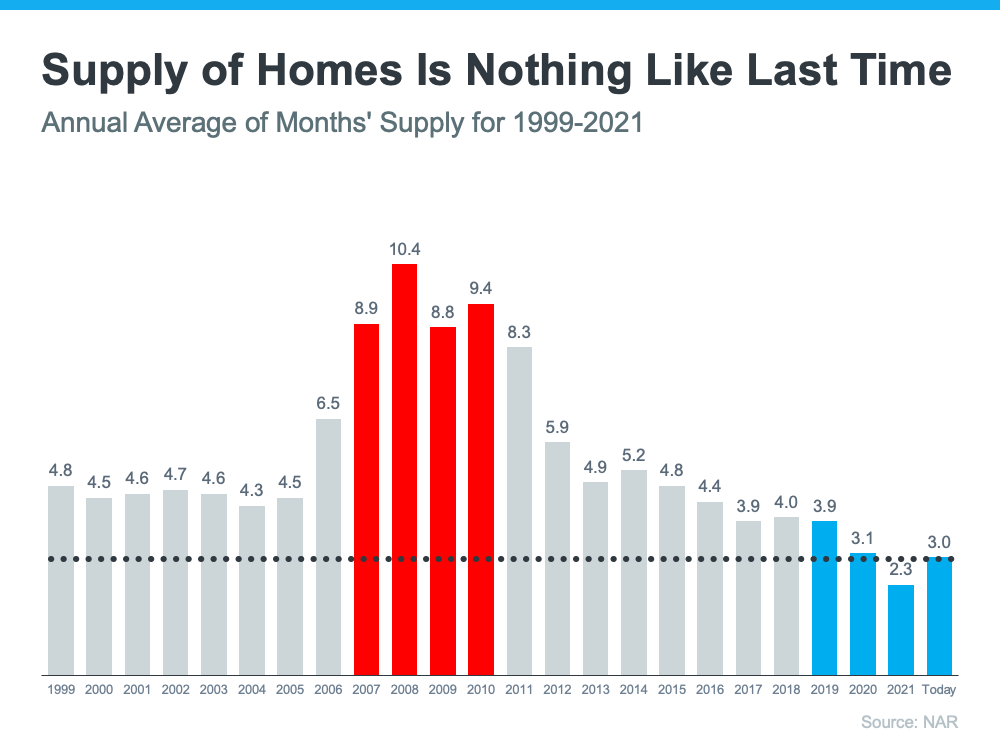
The supply of inventory needed to sustain a normal real estate market is approximately six months. Anything more than that is an overabundance and will causes prices to depreciate. Anything less than that is a shortage and will lead to continued price appreciation.
For historical context, there were too many homes for sale during the housing crisis (many of which were short sales and foreclosures), and that caused prices to tumble. Today, supply is growing, but there’s still a shortage of inventory available.
The graph below uses data from the National Association of Realtors (NAR) to show how this time compares to the crash. Today, unsold inventory sits at just a 3.0-months supply at the current sales pace.
One of the reasons inventory is still low is because of sustained underbuilding. When you couple that with ongoing buyer demand as millennials age into their peak homebuying years, it continues to put upward pressure on home prices. That limited supply compared to buyer demand is why experts forecast home prices won’t fall this time.
Mortgage Standards Were Much More Relaxed During the Crash
During the lead-up to the housing crisis, it was much easier to get a home loan than it is today. The graph below showcases data on the Mortgage Credit Availability Index (MCAI) from the Mortgage Bankers Association (MBA). The higher the number, the easier it is to get a mortgage.
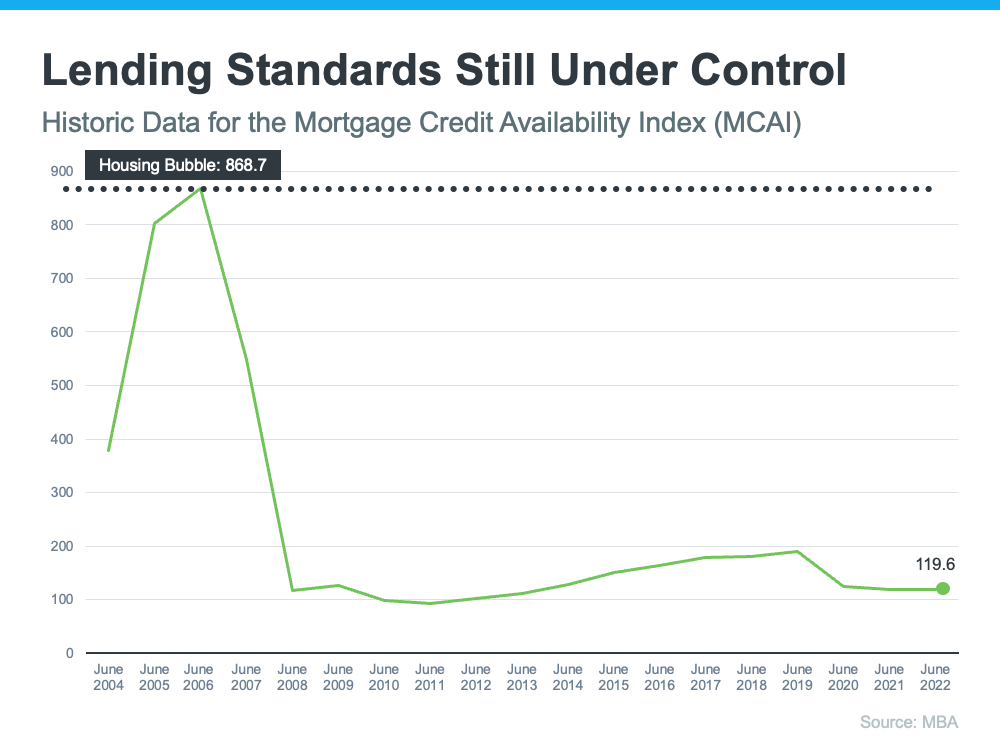
Running up to 2006, banks were creating artificial demand by lowering lending standards and making it easy for just about anyone to qualify for a home loan or refinance their current home. Back then, lending institutions took on much greater risk in both the person and the mortgage products offered. That led to mass defaults, foreclosures, and falling prices.
Today, things are different, and purchasers face much higher standards from mortgage companies. Mark Fleming, Chief Economist at First American, says:
“Credit standards tightened in recent months due to increasing economic uncertainty and monetary policy tightening.”
Stricter standards, like there are today, help prevent a risk of a rash of foreclosures like there was last time.
The Foreclosure Volume Is Nothing Like It Was During the Crash
The most obvious difference is the number of homeowners that were facing foreclosure after the housing bubble burst. Foreclosure activity has been on the way down since the crash because buyers today are more qualified and less likely to default on their loans. The graph below uses data from ATTOM Data Solutions to help tell the story:
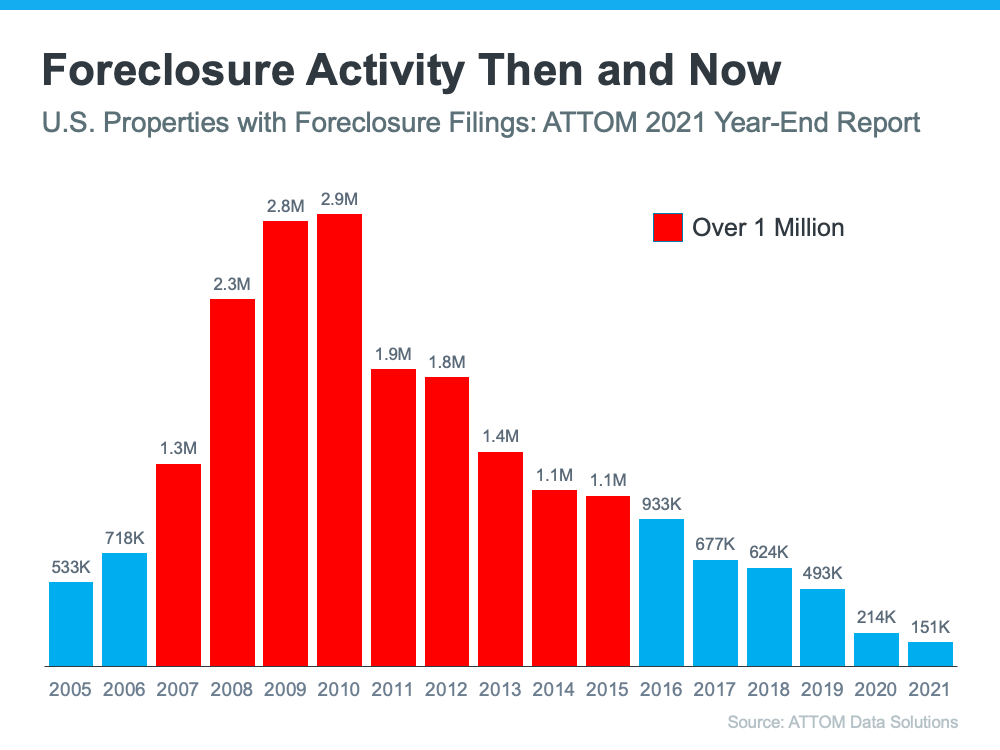
In addition, homeowners today are equity rich, not tapped out. In the run-up to the housing bubble, some homeowners were using their homes as personal ATMs. Many immediately withdrew their equity once it built up. When home values began to fall, some homeowners found themselves in a negative equity situation where the amount they owed on their mortgage was greater than the value of their home. Some of those households decided to walk away from their homes, and that led to a wave of distressed property listings (foreclosures and short sales), which sold at considerable discounts that lowered the value of other homes in the area.
Today, prices have risen nicely over the last few years, and that’s given homeowners an equity boost. According to Black Knight:
“In total, mortgage holders gained $2.8 trillion in tappable equity over the past 12 months – a 34% increase that equates to more than $207,000 in equity available per borrower. . . .”
With the average home equity now standing at $207,000, homeowners are in a completely different position this time.
Bottom Line
If you’re worried we’re making the same mistakes that led to the housing crash, the graphs above should help alleviate your concerns. Concrete data and expert insights clearly show why this is nothing like the last time. We study the real estate market every single day, so give us a call today at 734-761-3060 to talk about your particular condo or home buying or selling goals in today’s market at 734-761-3060 or email info@condohotline.com.
Looking for a Place To Call Home? Consider a Condominium.
It’s no secret that one of the top stories in today’s real estate market is low housing supply and high buyer demand. If you’re a first-time buyer looking for a starter home or are someone who’s interested in downsizing, it may be worth considering a condominium (condo) as a worthwhile option.
In fact, trends indicate condos are gaining popularity among buyers. In the latest Existing Homes Sales Report from the National Association of Realtors (NAR), the data shows condo sales rising throughout the first half of this year (see graph below):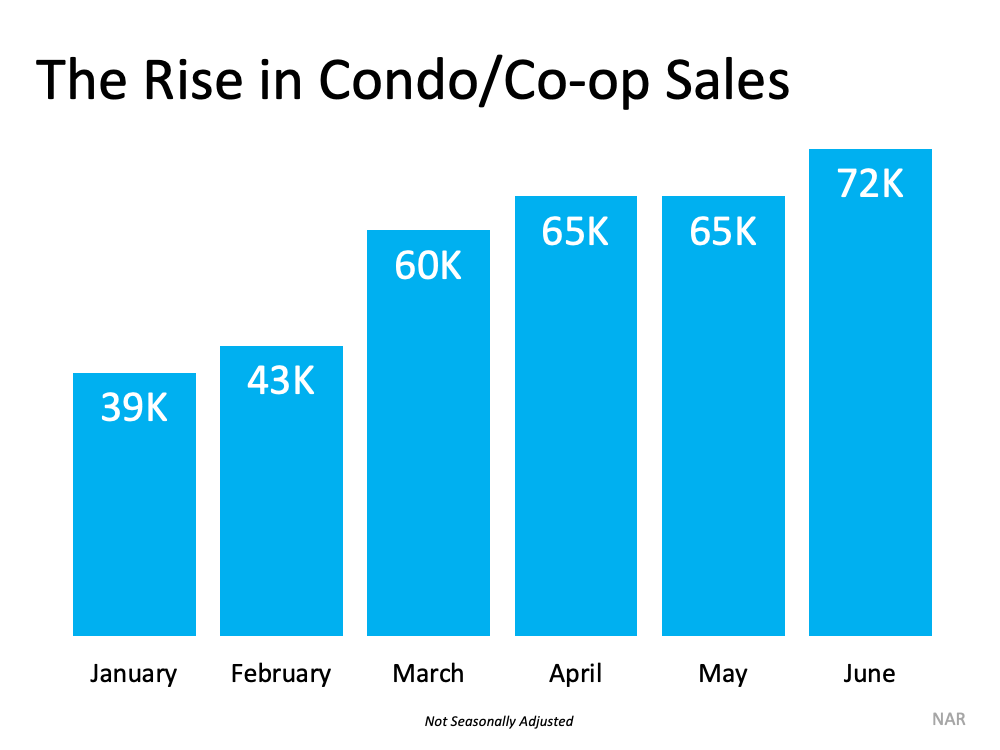
There are a few reasons more and more people are opting to buy condos – the benefits of condo life can be quite compelling. Let’s explore the main perks to find out if a condo is a good fit for you.
Affordability
According to the NAR report, the median sales price of a condo is roughly $59,000 less than the median price of a single-family detached home (see graph below). This makes condos a great option for first-time homebuyers, those with limited down payment savings, or those looking to save money by downsizing.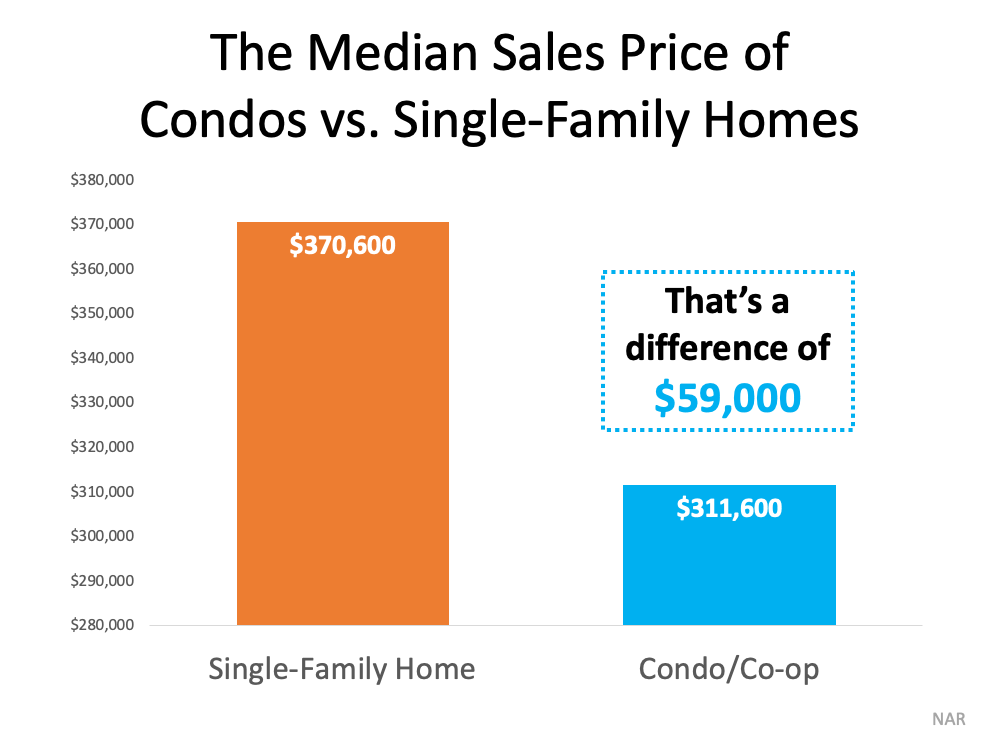
Maintenance
A recent article from BankRate adds low maintenance as another perk of a condo lifestyle. Generally, exterior maintenance for condos is handled by a Homeowner’s Association (HOA). This can include things like landscaping and upholding a certain standard of cleanliness and condition for walkways, siding, and roofs. If you’re looking for a lower-maintenance option or see the appeal in being hands-off with upkeep, condos may be a good choice for you. With exterior maintenance off your plate, you’ll have more time for yourself and your hobbies.
Amenities
You can use that free time to enjoy some of the value-adding features your condo community may have, which could include dog parks, pools, a rentable clubhouse and grilling area for events, and more. If being able to host or attend community social outings is important to you, condos may give you more opportunities to enjoy the company of your neighbors. As a bonus, some condos even have gyms and on-site security teams.
Ultimately, the choice is yours. Condos are great options that often come with various features and benefits that may be important for your lifestyle. Fannie Mae sums up the appeal nicely:
“Condominiums, or condos, can be great alternatives to detached homes. City dwellers, singles, couples, seniors, and many others may find condos that suit their needs and budgets. Others may simply prefer low-maintenance living. Buyers who feel ‘priced out’ of homes may discover condos offer an affordable homeownership alternative.”
Bottom Line
If you’re looking for a home, it may be time to consider a condo as an option. Let’s connect today at 734-761-3060 or info@condohotline.com to explore if one would be a good fit for your homeownership needs.
Is the Housing Market Correcting?

If you’re following the news, all of the headlines about conditions in the current housing market may leave you with more questions than answers. Is the boom over? Is the market crashing or correcting? Here’s what you need to know.
The housing market is moderating compared to the last two years, but what everyone needs to remember is that the past two years were record-breaking in nearly every way. Record-low mortgage rates and millennials reaching peak homebuying years led to an influx of buyer demand. At the same time, there weren’t enough homes available to purchase thanks to many years of underbuilding and sellers who held off on listing their homes due to the health crisis.
This combination led to record-high demand and record-low supply, and that wasn’t going to be sustainable for the long term. The latest data shows early signs of a shift back to the market pace seen in the years leading up to the pandemic – not a crash nor a correction. As realtor.com says:
“The housing market is at a turning point. . . . We’re starting to see signs of a new direction, . . .”
Home Showings Then and Now
The ShowingTime Showing Index tracks the traffic of home showings according to agents and brokers. It’s a good indication of buyer demand. Here’s a look at that data going back to 2019 (see graph below):
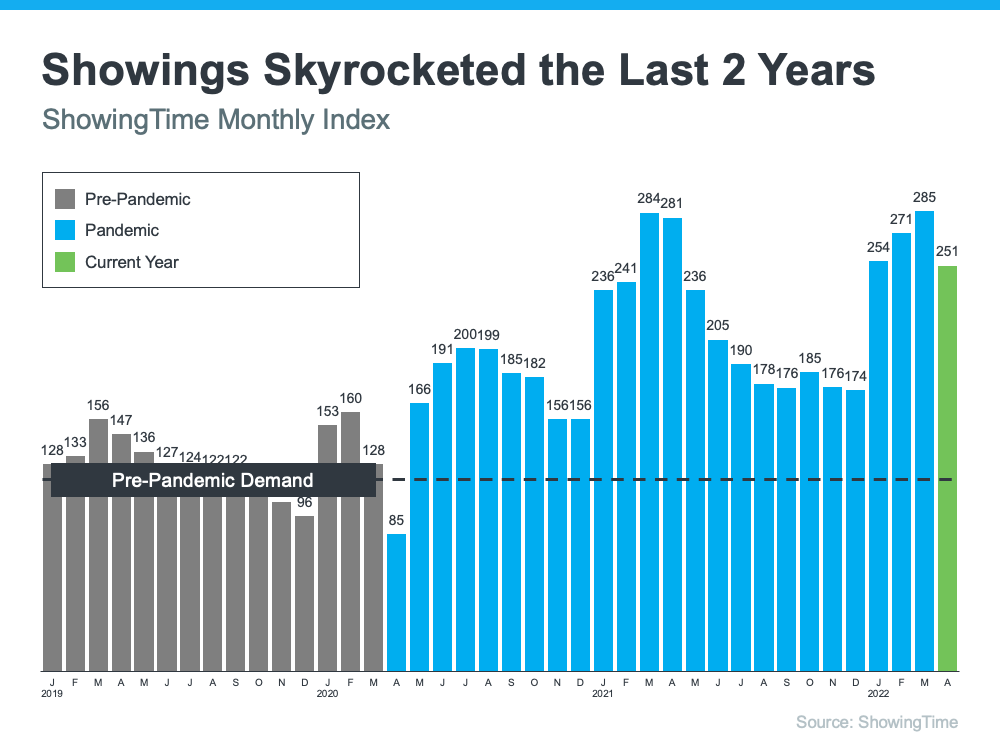
The 2019 numbers give a good baseline of pre-pandemic demand (shown in gray). As the graph indicates, home showings skyrocketed during the pandemic (shown in blue). And while current buyer demand has begun to moderate slightly based on the latest data (shown in green), showings are still above 2019 levels.
And since 2019 was such a strong year for the housing market, this helps show that the market isn’t crashing – it’s just at a turning point that’s moving back toward more pre-pandemic levels.
Existing Home Sales Then and Now
Headlines are also talking about how existing home sales are declining, but perspective matters. Here’s a look at existing home sales going all the way back to 2019 using data from the National Association of Realtors (NAR) (see graph below):
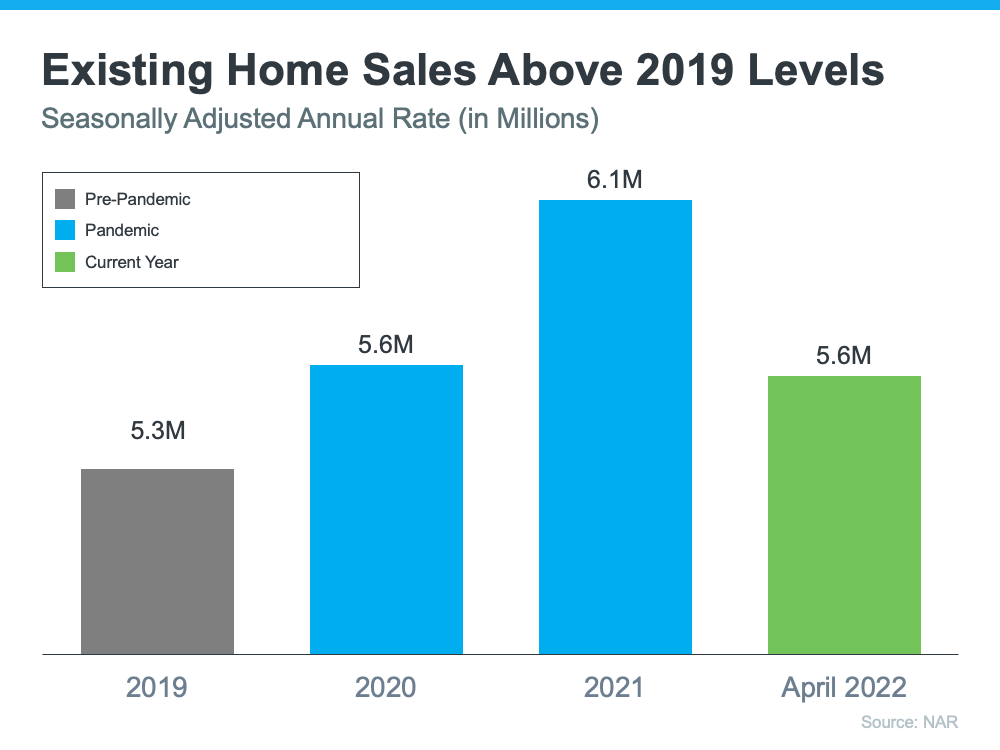
Again, a similar story emerges. The pandemic numbers (shown in blue) beat the more typical year of 2019 home sales (shown in gray). And according to the latest projections for 2022 (shown in green), the market is on pace to close this year with more home sales than in 2019 as well.
It’s important to compare today not to the abnormal pandemic years, but to the most recent normal year to show the current housing market is still strong. First American sums it up like this:
“. . . today’s housing market looks a lot like the 2019 housing market, which was the strongest housing market in a decade at the time.”
Bottom Line
If recent headlines are generating any concerns, look at a more typical year for perspective. The current market is not a crash or correction. It’s just a turning point toward more typical, pre-pandemic levels. Let’s connect at 734-761-3060 or info@condohotline.com if you have any questions about our local market and what it means for you when you buy or sell this year.
Is It Enough To Offer Asking Price in Today’s Housing Market?

If you’re planning to buy a home or condo this season, you’re probably thinking about what you’ll need to do to get your offer accepted. In previous years, it was common for buyers to try and determine how much less than the asking price they could offer to still get the property. The buyer and seller would then negotiate and typically agree on a revised price that was somewhere between the buyer’s bid and the home’s initial asking price.
In today’s real estate market, buyers shouldn’t shop for a home with the same expectations.
Things Are Different Today
Today’s housing market is anything but normal. According to the National Association of Realtors (NAR), the average property that’s sold today:
- Receives 4.8 offers
- Sells in just 17 days
Homes and condos selling quickly and receiving multiple offers show how competitive the market is for buyers right now. This is because there are more buyers on the market than properties for sale. When the number of homes available can’t keep up with demand, they often sell for more than the asking price.
How Does This Impact You When It’s Time To Submit an Offer?
Market conditions should help guide your decisions throughout the process. Today, the asking price is often the floor of the negotiation rather than the ceiling. Knowing this is important when it’s time to submit an offer, but you should also use that information as you’re searching too. After all, you don’t want to fall in love with a condo or home that ultimately sells for a price higher than what you’ve budgeted for.
The Mortgage Reports has advice if you’re looking to purchase a home or condo in a competitive market. The article encourages you to be realistic with your housing search, saying:
“The best thing to do is set your budget and expectations ahead of time so you know how much you can afford to offer — and when to walk away. This will make negotiations a lot easier.”
Of course, when you’ve found your dream home, you’ll want to do everything you can to submit your best offer upfront and win a potential bidding war. Knowing the current market is key to crafting a winning offer. That’s where working with an expert real estate advisor becomes critical.
A real estate professional will draw from their experience and expert-level knowledge of today’s housing market throughout the process. They’ll also balance conditions in your area to make sure your offer stands out above the rest.
Bottom Line
Understanding how to approach the asking price of a condo or home and what’s happening in today’s real estate market are critical for buyers. Let’s connect so we can work together to create a winning plan for you. Contact us today at 734-761-3060 or info@condohotline.com!
What Do Supply and Demand Tell Us About Today’s Housing Market?

There’s a well-known economic theory – the law of supply and demand – that explains what’s happening with prices in the current real estate market. Put simply, when demand for an item is high, prices rise. When the supply of the item increases, prices fall. Of course, when demand is very high and supply is very low, prices can rise significantly.
Understanding the impact both supply and demand have can provide the answers to a few popular questions about today’s housing market:
- Why are prices rising?
- Where are prices headed?
- What does this mean for homebuyers?
Why Are Prices Rising?
According to the latest Home Price Insights report from CoreLogic, condo and home prices have risen 18.1% since this time last year. But what’s driving the increase?
Recent buyer and seller activity data from the National Association of Realtors (NAR) helps answer that question. When we take NAR’s buyer activity data and compare it to the seller traffic during the same timeframe, we can see buyer demand continues to outpace seller activity by a wide margin. In other words, the demand for homes is significantly greater than the current supply that’s available to buy (see maps below): This combination of low supply and high demand is what’s driving condo and home prices up. Bill McBride, author of the Calculated Risk blog, puts it best, saying:
“By some measures, house prices seem high, but the recent price increases make sense from a supply and demand perspective.”
Where Are Prices Headed?
The supply of condos and homes for sale will greatly affect where prices head over the coming months. Many experts forecast prices will continue to increase, but they’ll likely appreciate at a slower rate.
Buyers hoping to purchase the home of their dreams may see this as welcome news. In this case, perspective is important: a slight moderation of prices does not mean prices will depreciate or fall. Price increases may occur at a slower pace, but experts still expect them to rise.
Five major entities that closely follow the real estate market forecast home prices will continue appreciating through 2022 (see graph below):
What Does This Mean for Buyers?
If you’re waiting to enter the market because you’re expecting prices to drop, you may end up paying more in the long run. Even if price increases occur at a slower rate next year, prices are still projected to rise. That means the home of your dreams will likely cost even more in 2022.
Bottom Line
The truth is, high demand and low supply are what’s driving up condo and home prices in today’s housing market. And while prices may increase at a slower pace in the coming months, experts still expect them to rise. If you’re a potential homebuyer, let’s connect today to discuss what that could mean for you if you wait even longer to buy.