
Mortgage Rates Are Dropping. What Does That Mean for You?
Mortgage Rates Are Dropping. What Does That Mean for You?

Mortgage rates have been a hot topic in the housing market over the past 12 months. Compared to the beginning of 2022, rates have risen dramatically. Now they’re dropping, and that has to do with everything happening in the economy.
Nadia Evangelou, Senior Economist and Director of Forecasting at the National Association of Realtors (NAR), explains it well by saying:
“Mortgage rates dropped even further this week as two main factors affecting today’s mortgage market became more favorable. Inflation continued to ease while the Federal Reserve switched to a smaller interest rate hike. As a result, according to Freddie Mac, the 30-year fixed mortgage rate fell to 6.31% from 6.33% the previous week.”
So, what does that mean for your homeownership plans? As mortgage rates fluctuate, they impact your purchasing power by influencing the cost of buying a home. Even a small dip can help boost your purchasing power. Here’s how it works.
The median-priced home according to the National Association of Realtors (NAR) is $379,100. So, let’s assume you want to buy a $400,000 home. If you’re trying to shop at that price point and keep your monthly payment about $2,500-2,600 or below, here’s how your purchasing power can change as mortgage rates move up or down (see chart below). The red shows payments above that threshold and the green indicates a payment within your target range.
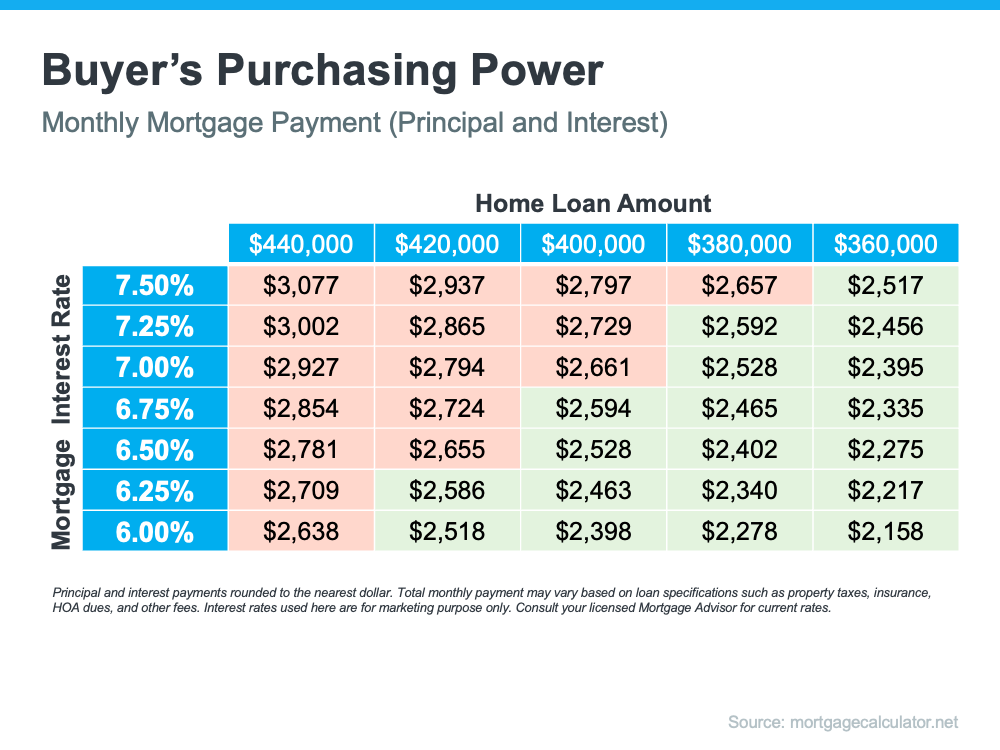
This goes to show, even a small quarter-point change in mortgage rates can impact your monthly mortgage payment. That’s why it’s important to work with a trusted real estate professional who follows what the experts are projecting for mortgage rates for the days, months, and year ahead.
Bottom Line
Mortgage rates are likely to fluctuate depending on what happens with inflation moving forward, but they have dropped slightly in recent weeks. If a 7% rate was too high for you, it may be time to contact a lender to see if the current rate is more in line with your goal for a monthly housing expense. Contact us today at 734-761-3060 to discuss your condo or home-owning plans and let our team of specialists help you achieve them! 734-761-3060 or info@condohotline.com.
Four Things That Help Determine Your Mortgage Rate

Four Things That Help Determine Your Mortgage Rate
If you’re looking to buy a condo or a home, you probably want to secure the lowest interest rate possible for your mortgage loan. Over the last couple of years, that was easier to do as the housing market saw record-low mortgage rates, but this year rates have risen dramatically.
If you’re looking for ways to combat today’s higher rates and lock in the lowest one you can, here are a few factors to focus on. Since approval opportunities can vary, connect with a trusted lender for customized advice.
Your Credit Score
Credit scores can play a big role in your mortgage rate. Freddie Mac explains:
“When you build and maintain strong credit, mortgage lenders have greater confidence when qualifying you for a mortgage because they see that you’ve paid back your loans as agreed and used your credit wisely. Strong credit also means your lender is more apt to approve you for a mortgage that has more favorable terms and a lower interest rate.”
That’s why it’s important to maintain a good credit score. If you want to focus on improving your score, your trusted advisor can give you expert advice to help.
Your Loan Type
There are many types of loans, each offering different terms for qualified buyers. The Consumer Financial Protection Bureau (CFPB) says:
“There are several broad categories of mortgage loans, such as conventional, FHA, USDA, and VA loans. Lenders decide which products to offer, and loan types have different eligibility requirements. Rates can be significantly different depending on what loan type you choose.”
When working with your real estate advisor, make sure you find out what’s available in your area and which types of loans you may qualify for.
Your Loan Term
Another factor to consider is the term of your loan. Just like with location and loan types, you have options. Freddie Mac says:
“When choosing the right home loan for you, it’s important to consider the loan term, which is the length of time it will take you to repay your loan before you fully own your home. Your loan term will affect your interest rate, monthly payment, and the total amount of interest you will pay over the life of the loan.”
Depending on your situation, the length of your loan can also change your mortgage rate.
Your Down Payment
If you’re a current homeowner looking to sell and make a move, you can use the home equity you’ve built over time toward the down payment on your next home. The CFPB explains:
“In general, a larger down payment means a lower interest rate, because lenders see a lower level of risk when you have more stake in the property. So if you can comfortably put 20 percent or more down, do it—you’ll usually get a lower interest rate.”
To learn more, connect with a lender to find out the difference a higher down payment can make for your new mortgage. We have a terrific list of local lenders, just ask us!
Bottom Line
These are just a few factors that can help determine your mortgage rate if you’re buying a condo or home. The best thing you can do is have a team of professionals on your side. Connect with us, The Bouma Group, your local real estate professionals, and a trusted lender so you have the expert advice you need at each step of the process. Contact us today at 734-761-3060 or info@condohotline.com.
Two Reasons Why Waiting a Year To Buy Could Cost You

If you’re a renter with a desire to become a homeowner or a homeowner who’s decided your current place no longer fits your needs, you may be hoping that waiting a year might mean better market conditions to purchase a condo or home.
To determine if you should buy now or wait, you need to ask yourself two simple questions:
- What will home prices be like in 2022?
- Where will mortgage rates be by the end of 2022?
Let’s shed some light on the answers to both of these questions.
What will home prices be like in 2022?
Three major housing industry entities project continued home price appreciation for 2022. Here are their forecasts:
- Freddie Mac: 5.3%
- Fannie Mae: 5.1%
- Mortgage Bankers Association: 8.4%
Using the average of the three projections (6.27%), a condo that sells for $350,000 today would be valued at $371,945 by the end of next year. That means, if you delay, it could cost you more. As a prospective buyer, you could pay an additional $21,945 if you wait.
Where will mortgage rates be by the end of 2022?
Today, the 30-year fixed mortgage rate is hovering near historic lows. However, most experts believe rates will rise as the economy continues to recover. Here are the forecasts for the fourth quarter of 2022 by the three major entities mentioned above:
- Freddie Mac: 3.8%
- Fannie Mae: 3.2%
- Mortgage Bankers Association: 4.2%
That averages out to 3.7% if you include all three forecasts, and it’s nearly a full percentage point higher than today’s rates. Any increase in mortgage rates will increase your cost.
What does it mean for you if both home values and mortgage rates rise?
You’ll pay more in mortgage payments each month if both variables increase. Let’s assume you purchase a $350,000 condo or home this year with a 30-year fixed-rate loan at 2.86% after making a 10% down payment. According to the mortgage calculator from Smart Asset, your monthly mortgage payment (including principal and interest payments, and estimated home insurance, taxes in your area, and other fees) would be approximately $1,899.
That same condo or home could cost $371,945 by the end of 2022, and the mortgage rate could be 3.7% (based on the industry forecasts mentioned above). Your monthly mortgage payment, after putting down 10%, would increase to $2,166.
The difference in your monthly mortgage payment would be $267. That’s $3,204 more per year and $96,120 over the life of the loan.
If you consider that purchasing now will also let you take advantage of the equity you’ll build up over the next calendar year, which is approximately $22,000 for a house with a similar value, then the total net worth increase you could gain from buying this year is over $118,000.
Bottom Line
When asking if you should buy a condo or home, you probably think of the non-financial benefits of owning property as a driving motivator. When asking when to buy, the financial benefits make it clear that doing so now is much more advantageous than waiting until next year.
What Are the Benefits of a 20% Down Payment?

If you’re thinking of buying a condo this year, you may be wondering how much money you need to come up with for your down payment. Many people may think it’s 20% of the loan to secure a mortgage. While there are plenty of lower down payment options available for qualified buyers who don’t want to put 20% down, it’s important to understand how a larger down payment can have great benefits too.
The truth is, there are many programs available that allow you to put down as little as 3.5%, which can be a huge benefit to those who want to purchase a condo sooner rather than later. Those who have served our country may also qualify for a Veterans Affairs Home Loan (VA) and may not need a down payment. These programs have really cut down the savings time for many potential buyers, enabling them to start building family wealth sooner.
Here are four reasons why putting 20% down is a good plan if you can afford it.
1. Your interest rate may be lower.
A 20% down payment vs. a 3-5% down payment shows your lender you’re more financially stable and not a large credit risk. The more confident your lender is in your credit score and your ability to pay your loan, the lower the mortgage interest rate they’ll likely be willing to give you.
2. You’ll end up paying less for your condo.
The larger your down payment, the smaller your loan amount will be for your mortgage. If you’re able to pay 20% of the cost of your new home at the start of the transaction, you’ll only pay interest on the remaining 80%. If you put down 5%, the additional 15% will be added to your loan and will accrue interest over time. This will end up costing you more over the lifetime of your home loan.
3. Your offer will stand out in a competitive market.
In a market where many buyers are competing for the same property, sellers like to see offers come in with 20% or larger down payments. The seller gains the same confidence as the lender in this scenario. You are seen as a stronger buyer with financing that’s more likely to be approved. Therefore, the deal will be more likely to go through.
4. You won’t have to pay Private Mortgage Insurance (PMI)
What is PMI? According to Freddie Mac:
“PMI is an insurance policy that protects the lender if you are unable to pay your mortgage. It’s a monthly fee, rolled into your mortgage payment, that is required for all conforming, conventional loans that have down payments less than 20%. Once you’ve built equity of 20% in your home, you can cancel your PMI and remove that expense from your mortgage payment.”
As mentioned earlier, when you put down less than 20% when buying a condo or home, your lender will see your loan as having more risk. PMI helps them recover their investment in you if you’re unable to pay your loan. This insurance isn’t required if you’re able to put down 20% or more.
Many times, sellers looking to move up to a larger or more expensive home are able to take the equity they earn from the sale of their property to put down 20% on their next. With the equity homeowners have today, it creates a great opportunity to put those savings toward a 20% or greater down payment on a new condo or home.
If you’re looking to buy your first place, you’ll want to consider the benefits of 20% down versus a smaller down payment option.
Bottom Line
If you’re thinking of buying a condo and are already saving for your down payment, let’s connect to discuss what fits best with your long-term plans. Contact us today at 734-761-3060 or info@condohotline.com.