
Ann Arbor Condo Spring 2024 Market Update
Ann Arbor Condo Spring 2024

The Ann Arbor condo market is buzzing with activity as we advance into the Spring of 2024. The city, always evolving and dynamic, showcases its versatility in the real estate market. With a diverse range of available properties, from the most accessible to the pinnacle of luxury, there is movement across all segments.
Active listings sit at a substantial 80 condos. The market’s temperature can be further inferred from the 52 of these condos are already under contract, hinting at the high demand for living spaces in this vibrant city.
For those on the lookout for affordable options, Ann Arbor extends an inviting hand. Of the 25 condos listed under the $300,000 mark, a striking 80% are under contract—a clear message about the competitive nature of this price segment. The fact that the lowest-priced condo at $178,000 is also under contract is a testament to the allure of more reasonably priced homes, encouraging quick action from buyers.
The luxury market stands strong at the opposite end of the spectrum. A condo boasts the highest price tag at a whopping $1,950,000, setting a benchmark for the opulence available within Ann Arbor’s condo offerings.
New Construction Condos

New construction continues to play a significant role in Ann Arbor’s real estate narrative with 44 condos listed for sale. This marks an encouraging sign of growth, ensuring the market remains vibrant and caters to modern tastes and standards. Most remarkably, an overwhelming majority of these new properties—27 out of 44—are already under contract, a nod to their desirability and the city’s relentless appeal.
Sold Condos
So far this year, 111 condos have already sailed past the sold status. These units ranged from a more affordable $130,000 to a grand $1,400,000, indicative of the diverse buyers in the Ann Arbor market. For those eyeing the statistics, the average sale price sits at $411,611, with the average price per square foot rounding out at $301. These numbers aren’t just digits; they’re a benchmark of the value that Ann Arbor condos hold and a metric for prospective investors or homeowners to consider.
In summary, the Spring 2024 Ann Arbor condo market is lively and diverse. With a strong start to 2024, and the trend showing a weighted distribution towards seller advantage, now might be the perfect time to consider stepping into or moving up within this dynamic market. Whether you’re searching for affordability or opulence, Ann Arbor’s condos are opening their doors to meet you halfway. Contact us today for a curated list of units as soon as they hit the market at 734-761-3060 or info@condohotline.com.
The Latest Expert Forecasts for Home Prices in 2023
Are Home Prices Dropping or Increasing?
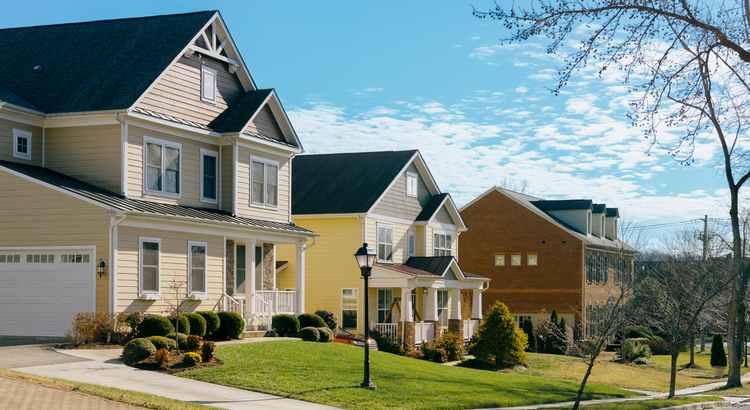
Are you thinking about making a move? If so, all the speculation that home prices would crash this year may have you feeling a bit on edge about your decision. Let the data and the experts reassure you. Prices aren’t in a downward spiral and will actually finish the year strong.
Even though you may have heard talk that prices would drop 5, 10, or even 20% this year, that hasn’t happened. The big reason why is the supply of homes for sale is too low. There are just more buyers looking to buy than homes available, and that’s kept prices from falling.
To prove this year wasn’t a bust for home prices, let’s look at the latest 2023 forecast from a number of experts.
Most Experts Project Home Prices Will Net Positive This Year
The general consensus from industry experts is that home price appreciation will actually be positive for 2023. The graph below shows the latest 2023 year-end forecasts from six different organizations:

As you can see, all but one project nationally prices will net positive this year. That’s significant because it shows the majority are optimistic about home price growth.
If you’re still worried about the one red bar that shows an overall price drop for the year, think about this. The projection from the National Association of Realtors (NAR) is for only a slight decline. It’s not the big crash all the headlines called for. Plus, if you average all six forecasts together, the expectation is that prices will net somewhere around 3.3% positive growth for the year.
If these 6 organizations aren’t enough to convince you that prices won’t come tumbling down, here’s something else to consider. One of the six forecasts represented in the graph is the Home Price Expectation Survey (HPES) from Pulsenomics. It combines survey results from over 100 economists, investment strategists, and housing market analysts. The HPES found that the average from all 100 of those experts is 3.3% price growth for the year.
If you look back at the graph above, you’ll notice the blue average for the forecasts in this graph is also 3.3%. While individual forecasts may vary, both the HPES survey and the average of these forecasts provide the same projection. And 3.3% appreciation is a completely different story than prices falling.
Ann Arbor Area Home Prices
In the Ann Arbor Area, we are seeing an increase in home and condo prices so far this year. Since January 1st, 2023, the average sale price of condos has increased by 2.7% and is now $353,761. Single-family homes saw an increase of 6.1% and sits at $488,726. Ann Arbor is also experiencing a serious lack of inventory which continues to drive values up. Get the full Ann Arbor Condo market update here.
Bottom Line
If you’re worried about home prices falling this year, let the experts reassure you. Based on the average of the latest forecasts, home prices will actually show positive growth this year. If you have questions about what’s happening with home prices in our local area, let’s connect today at 734-761-3060 or info@condohotline.com.
Ann Arbor Condo Market Update – Fall 2023
Ann Arbor Condo Market Update for Fall 2023

The Fall 2023 condo real estate market is here and with it the hopes of a renewed increase in buyer activity. But first, let’s take a look at the statistics from the first half of the year.
Year-to-Date Condo Stats
Comparing statistics from the first half of 2022 to 2023 we’ve seen:
- New listings decreased by 16.8% going from 917 to 763 condos listed for sale YTD.
- Pending sales, the number of units that have gone under contract with a buyer, decreased 5.8% from 728 last year to 686 this year.
- 740 condos closed last year with 634 this year making a 14.3% decrease.
- Average sale price increased by 2.7% bringing it to $353,761.
April was the top listing month with 135 condos listed for sale and was also the busiest month for buyer activity with 146 pended units. June had the most closings with 114, which makes sense since it typically takes 30-45 days to close from the time of a bottom-lined offer. Due to the shrinking number of condos being listed for sale, the average sale price is continuing to increase because of a lack of availability. Prices will likely begin to stabilize once more inventory becomes available and that may not happen until mortgage interest rates cool off.
Downtown Ann Arbor Condos
In the downtown Ann Arbor area, there are currently 25 active listings, plus 10 pending with a buyer. So far this year, 71 condos have sold with an average sale price of $567,586. Compared to this time last year, there were 106 sales with an average sale price of $525,528. The number of closed sales decreased by 33% YTD and the average sale price increased by 8% following the trend of all Ann Arbor condos.
Fall 2023
The Ann Arbor condo market is beginning the fall season with 130 units listed for sale with 57 of those under contract. That leaves 69 condos available for a buyer to purchase. 38 of these are new construction with 14 under contract. Let’s take a look by price point:

With mortgage interest rates still climbing, affordability comes into play as you can see by the slower movement in the higher price points. Buyers need to remain vigilant in their search and be aware when new listings come to the market. Sellers, in higher price points especially, need a Realtor who knows their market niche and the inuendos of their community so they price accordingly. For more information on buying and selling in the Ann Arbor Condo market, contact the Real Estate specialists with The Bouma Group at 734-761-3060 or info@condohotline.com today!
Data was gathered from the Ann Arbor Area Board of Realtors
Buyer Activity Is Up Despite Higher Mortgage Rates
Showing Traffic Equals Buyer Activity

If you’re a homeowner thinking about making a move, you may wonder if it’s still a good time to sell your condo or house. Here’s the good news. Even with higher mortgage rates, buyer activity is actually picking up speed.
Data from the latest ShowingTime Showing Index, which is a measure of buyers actively touring homes, helps paint the picture of how much buyer demand has increased in recent months (see graph below):

As the graph shows, the first two months of 2023 saw a noticeable increase in buyer traffic. That’s likely because the limited number of homes for sale kept shoppers looking for homes even during colder months.
To help tell the story of why the latest report is significant, let’s compare foot traffic this February with each February for the last six years (see graph below). It shows this was one of the best Februarys for buyer activity we’ve seen in recent memory.

In the last six years, we saw the most February buyer traffic in 2021 and 2022 (shown in green above), but those years were highly unusual for the housing market. So, if we compare February 2023 with the more normal, pre-pandemic years, data shows this year still marks a clear rise in buyer activity.
The uptick in buyer traffic is even more noteworthy considering the increase in mortgage rates this February. The Freddie Mac 30-year fixed mortgage rate rose from 6.09% during the week of February 2nd to 6.50% in the week of February 23rd. But even with higher rates, more buyers were looking for a home.
Jeff Tucker, Senior Economist at Zillow, says the increased buyer activity could continue:
“More buyers will keep coming out of the woodwork. We always see a seasonal uptick in home shoppers in March and April . . .”
If you’re looking to sell your condo or home, seeing buyers still active in the market this year should be encouraging. It’s a sign buyers are out there and could be looking for a place just like yours. Working with a real estate professional to list your condo or house now will help you get your home in front of eager buyers today.
Bottom Line
Rising foot traffic is a bright spot for this year’s housing market and indicates that buyers are looking to purchase this year, even with higher mortgage rates. If you’re ready to sell condo your house, let’s connect. Contact us at The Bouma Group, Realtors today at 734-761-3060 or info@condohotline.com.
Is the Real Estate Market Slowing Down, or Is This a Housing Bubble?

The talk of a housing bubble in the coming year seems to be at a fever pitch as rising mortgage rates continue to slow down an overheated real estate market. Over the past two years, home prices have appreciated at an unsustainable pace causing many to ask: are things just slowing down, or is a crash coming?
To answer this question, there are two things we want to understand. The first is the reality of the shift in today’s housing market. And the second is what experts are saying about home prices in the coming year.
The Reality of the Shift in Today’s Housing Market
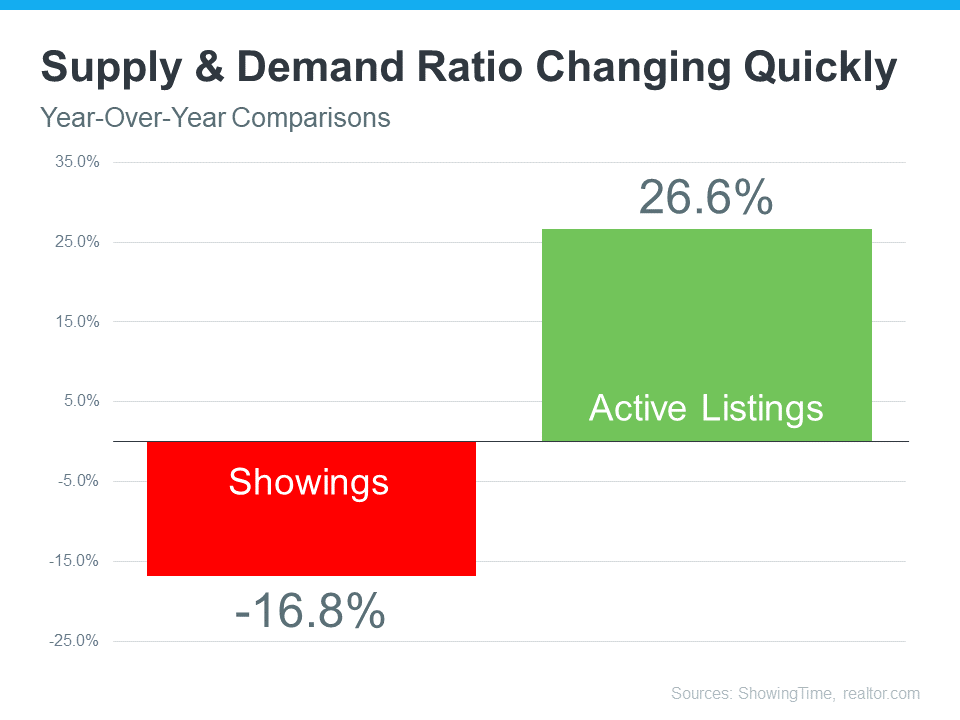
The reality is we’re seeing an inflection point in housing supply and demand. According to realtor.com, active listings have increased more than 26% over last year, while showings from the latest ShowingTime Showing Index have decreased almost 17% from last year (see graph below). This is an inflection point for housing because, over the past two years, we’ve seen a massive amount of demand (showings) and not enough homes available for sale for the number of people that wanted to buy. That caused the market frenzy.
Today, supply and demand look very different, and the market is slowing down from the pace we’ve seen. This offers proof of the sudden slowdown so many people are feeling.
What Experts Are Saying About Home Prices in the Coming Year
Right now, most experts are forecasting home price appreciation in 2023, but at a much slower pace than the last two years. The average of the six forecasters below is for national home prices to appreciate by 2.5% in the coming year. Only one of the six is calling for home price depreciation.
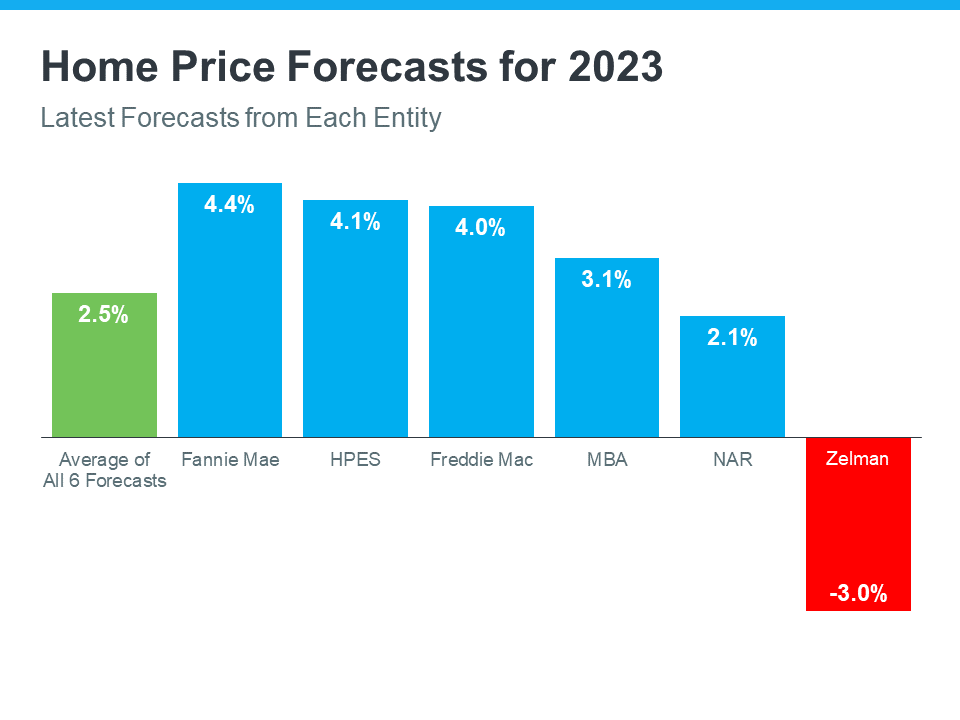
When we look at the shift taking place along with what experts are saying, we can conclude the national real estate market is slowing down but is not a bubble getting ready to burst. This isn’t to say that a few overheated markets won’t experience home price depreciation, but there isn’t a case to be made for a national housing bubble.
Bottom Line
The real estate market is slowing down, and that’s causing many to fear we’re in a housing bubble. What we’ve experienced in the housing market over the past two years were historic levels of demand and constrained supply. That led to homes going up in value at a record pace. While some overheated markets may experience price depreciation in the short term, according to experts, the national real estate market will appreciate in the coming year. Thinking about buying or selling a condo or home soon? Let’s connect and talk about your specific needs! Contact us at 734-761-3060 or info@condohotline.com today!
3 Graphs To Show This Isn’t a Housing Bubble
With all the headlines and buzz in the media, some consumers believe the market is in a housing bubble. As the housing market shifts, you may be wondering what’ll happen next. It’s only natural for concerns to creep in that it could be a repeat of what took place in 2008. The good news is, there’s concrete data to show why this is nothing like the last time.
There’s a Shortage of Homes on the Market Today, Not a Surplus
The supply of inventory needed to sustain a normal real estate market is approximately six months. Anything more than that is an overabundance and will causes prices to depreciate. Anything less than that is a shortage and will lead to continued price appreciation.
For historical context, there were too many homes for sale during the housing crisis (many of which were short sales and foreclosures), and that caused prices to tumble. Today, supply is growing, but there’s still a shortage of inventory available.
The graph below uses data from the National Association of Realtors (NAR) to show how this time compares to the crash. Today, unsold inventory sits at just a 3.0-months supply at the current sales pace.
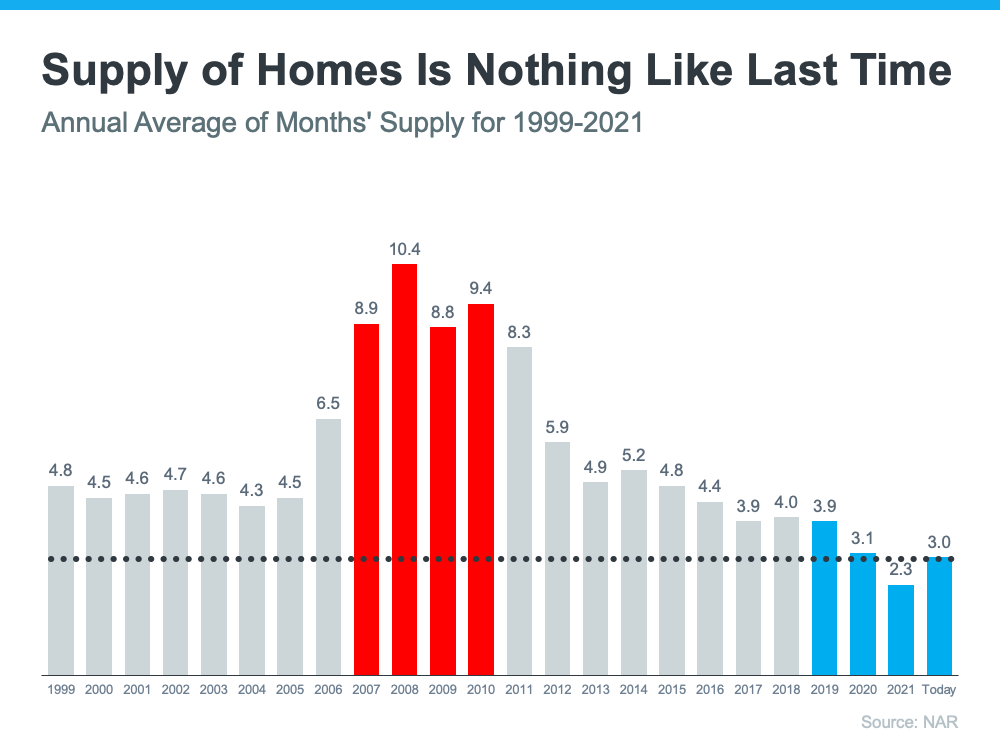
One of the reasons inventory is still low is because of sustained underbuilding. When you couple that with ongoing buyer demand as millennials age into their peak homebuying years, it continues to put upward pressure on home prices. That limited supply compared to buyer demand is why experts forecast home prices won’t fall this time.
Mortgage Standards Were Much More Relaxed During the Crash
During the lead-up to the housing crisis, it was much easier to get a home loan than it is today. The graph below showcases data on the Mortgage Credit Availability Index (MCAI) from the Mortgage Bankers Association (MBA). The higher the number, the easier it is to get a mortgage.
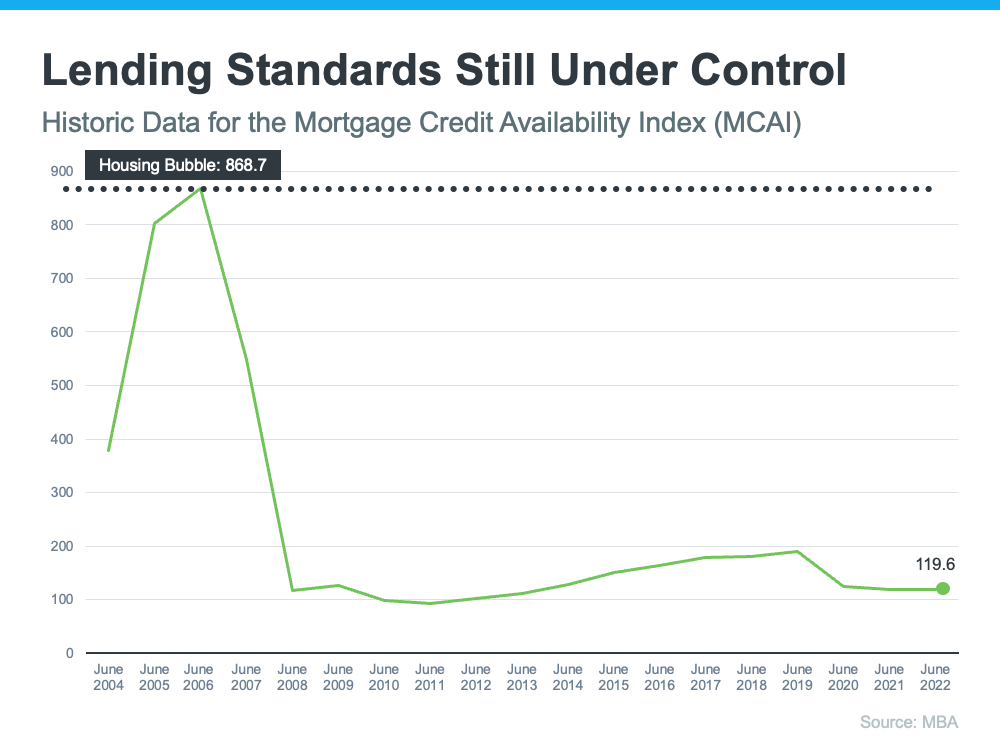
Running up to 2006, banks were creating artificial demand by lowering lending standards and making it easy for just about anyone to qualify for a home loan or refinance their current home. Back then, lending institutions took on much greater risk in both the person and the mortgage products offered. That led to mass defaults, foreclosures, and falling prices.
Today, things are different, and purchasers face much higher standards from mortgage companies. Mark Fleming, Chief Economist at First American, says:
“Credit standards tightened in recent months due to increasing economic uncertainty and monetary policy tightening.”
Stricter standards, like there are today, help prevent a risk of a rash of foreclosures like there was last time.
The Foreclosure Volume Is Nothing Like It Was During the Crash
The most obvious difference is the number of homeowners that were facing foreclosure after the housing bubble burst. Foreclosure activity has been on the way down since the crash because buyers today are more qualified and less likely to default on their loans. The graph below uses data from ATTOM Data Solutions to help tell the story:
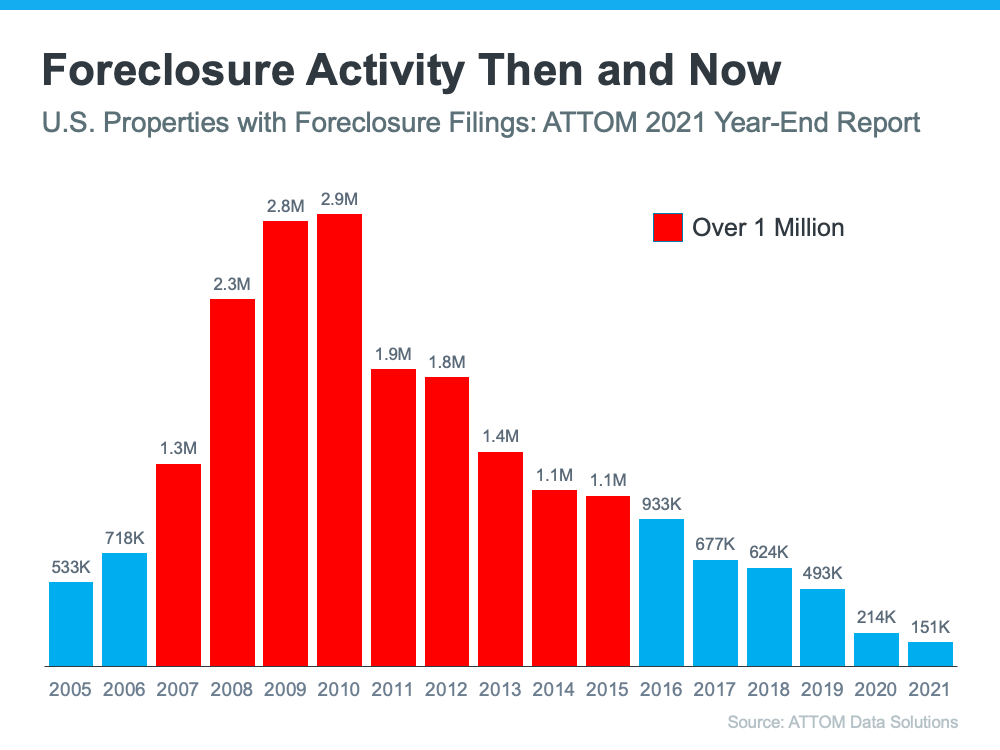
In addition, homeowners today are equity rich, not tapped out. In the run-up to the housing bubble, some homeowners were using their homes as personal ATMs. Many immediately withdrew their equity once it built up. When home values began to fall, some homeowners found themselves in a negative equity situation where the amount they owed on their mortgage was greater than the value of their home. Some of those households decided to walk away from their homes, and that led to a wave of distressed property listings (foreclosures and short sales), which sold at considerable discounts that lowered the value of other homes in the area.
Today, prices have risen nicely over the last few years, and that’s given homeowners an equity boost. According to Black Knight:
“In total, mortgage holders gained $2.8 trillion in tappable equity over the past 12 months – a 34% increase that equates to more than $207,000 in equity available per borrower. . . .”
With the average home equity now standing at $207,000, homeowners are in a completely different position this time.
Bottom Line
If you’re worried we’re making the same mistakes that led to the housing crash, the graphs above should help alleviate your concerns. Concrete data and expert insights clearly show why this is nothing like the last time. We study the real estate market every single day, so give us a call today at 734-761-3060 to talk about your particular condo or home buying or selling goals in today’s market at 734-761-3060 or email info@condohotline.com.
Is the Housing Market Correcting?

If you’re following the news, all of the headlines about conditions in the current housing market may leave you with more questions than answers. Is the boom over? Is the market crashing or correcting? Here’s what you need to know.
The housing market is moderating compared to the last two years, but what everyone needs to remember is that the past two years were record-breaking in nearly every way. Record-low mortgage rates and millennials reaching peak homebuying years led to an influx of buyer demand. At the same time, there weren’t enough homes available to purchase thanks to many years of underbuilding and sellers who held off on listing their homes due to the health crisis.
This combination led to record-high demand and record-low supply, and that wasn’t going to be sustainable for the long term. The latest data shows early signs of a shift back to the market pace seen in the years leading up to the pandemic – not a crash nor a correction. As realtor.com says:
“The housing market is at a turning point. . . . We’re starting to see signs of a new direction, . . .”
Home Showings Then and Now
The ShowingTime Showing Index tracks the traffic of home showings according to agents and brokers. It’s a good indication of buyer demand. Here’s a look at that data going back to 2019 (see graph below):
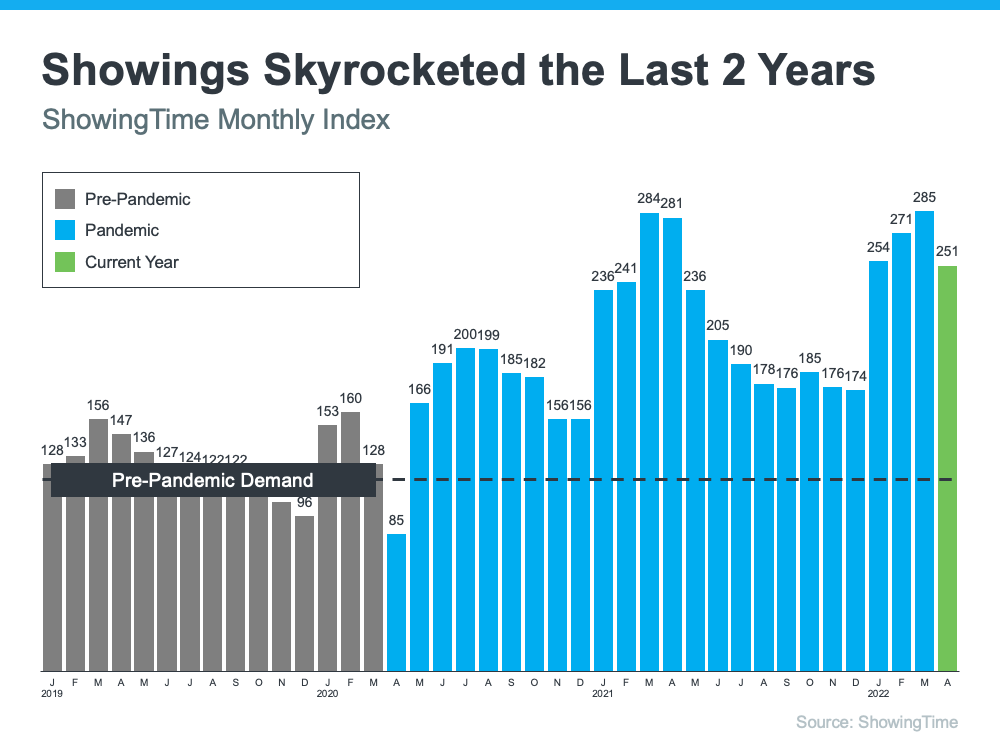
The 2019 numbers give a good baseline of pre-pandemic demand (shown in gray). As the graph indicates, home showings skyrocketed during the pandemic (shown in blue). And while current buyer demand has begun to moderate slightly based on the latest data (shown in green), showings are still above 2019 levels.
And since 2019 was such a strong year for the housing market, this helps show that the market isn’t crashing – it’s just at a turning point that’s moving back toward more pre-pandemic levels.
Existing Home Sales Then and Now
Headlines are also talking about how existing home sales are declining, but perspective matters. Here’s a look at existing home sales going all the way back to 2019 using data from the National Association of Realtors (NAR) (see graph below):
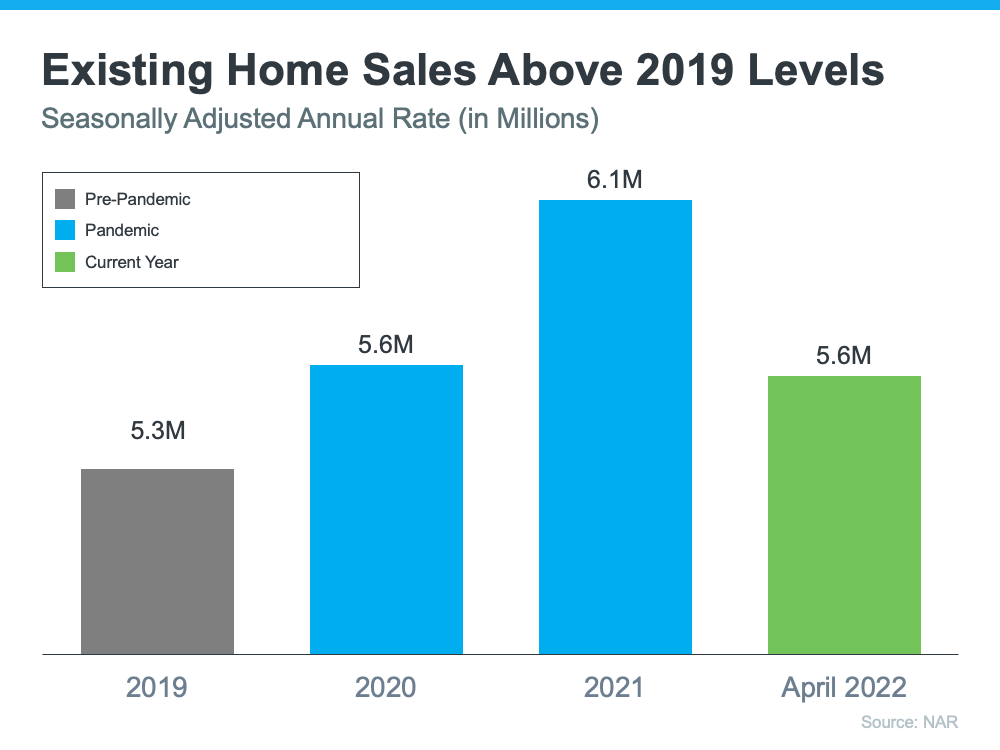
Again, a similar story emerges. The pandemic numbers (shown in blue) beat the more typical year of 2019 home sales (shown in gray). And according to the latest projections for 2022 (shown in green), the market is on pace to close this year with more home sales than in 2019 as well.
It’s important to compare today not to the abnormal pandemic years, but to the most recent normal year to show the current housing market is still strong. First American sums it up like this:
“. . . today’s housing market looks a lot like the 2019 housing market, which was the strongest housing market in a decade at the time.”
Bottom Line
If recent headlines are generating any concerns, look at a more typical year for perspective. The current market is not a crash or correction. It’s just a turning point toward more typical, pre-pandemic levels. Let’s connect at 734-761-3060 or info@condohotline.com if you have any questions about our local market and what it means for you when you buy or sell this year.
Two Reasons Why Waiting a Year To Buy Could Cost You

If you’re a renter with a desire to become a homeowner or a homeowner who’s decided your current place no longer fits your needs, you may be hoping that waiting a year might mean better market conditions to purchase a condo or home.
To determine if you should buy now or wait, you need to ask yourself two simple questions:
- What will home prices be like in 2022?
- Where will mortgage rates be by the end of 2022?
Let’s shed some light on the answers to both of these questions.
What will home prices be like in 2022?
Three major housing industry entities project continued home price appreciation for 2022. Here are their forecasts:
- Freddie Mac: 5.3%
- Fannie Mae: 5.1%
- Mortgage Bankers Association: 8.4%
Using the average of the three projections (6.27%), a condo that sells for $350,000 today would be valued at $371,945 by the end of next year. That means, if you delay, it could cost you more. As a prospective buyer, you could pay an additional $21,945 if you wait.
Where will mortgage rates be by the end of 2022?
Today, the 30-year fixed mortgage rate is hovering near historic lows. However, most experts believe rates will rise as the economy continues to recover. Here are the forecasts for the fourth quarter of 2022 by the three major entities mentioned above:
- Freddie Mac: 3.8%
- Fannie Mae: 3.2%
- Mortgage Bankers Association: 4.2%
That averages out to 3.7% if you include all three forecasts, and it’s nearly a full percentage point higher than today’s rates. Any increase in mortgage rates will increase your cost.
What does it mean for you if both home values and mortgage rates rise?
You’ll pay more in mortgage payments each month if both variables increase. Let’s assume you purchase a $350,000 condo or home this year with a 30-year fixed-rate loan at 2.86% after making a 10% down payment. According to the mortgage calculator from Smart Asset, your monthly mortgage payment (including principal and interest payments, and estimated home insurance, taxes in your area, and other fees) would be approximately $1,899.
That same condo or home could cost $371,945 by the end of 2022, and the mortgage rate could be 3.7% (based on the industry forecasts mentioned above). Your monthly mortgage payment, after putting down 10%, would increase to $2,166.
The difference in your monthly mortgage payment would be $267. That’s $3,204 more per year and $96,120 over the life of the loan.
If you consider that purchasing now will also let you take advantage of the equity you’ll build up over the next calendar year, which is approximately $22,000 for a house with a similar value, then the total net worth increase you could gain from buying this year is over $118,000.
Bottom Line
When asking if you should buy a condo or home, you probably think of the non-financial benefits of owning property as a driving motivator. When asking when to buy, the financial benefits make it clear that doing so now is much more advantageous than waiting until next year.
Ann Arbor Condo Report – August 2021
Approximately 20% Increase in Average Sales Price
Both monthly and year-to-date statistics saw a decent increase in the average sale price. In the month of August, Ann Arbor condos had an ASP of $312,212, which was a 24.9% increase from the ASP of $250,020 last August. As well, closed sales rose 10.1% from 69 to 76 condos now. Sellers will also be happy to know that the average days on the market decreased to 29 days, a 35.6% decrease. The amount of listings declined by 5% from 101 to 96 units.
So far in 2021, 788 condos have been listed for sale which is a 10.1% increase compared to the 716 last year. A total of 590 units have been sold since the start of the year versus the 452 previously, a 30.5% rise. The average sale price has increased by 20.3% from $270,011 to $324,765 currently.
For more information about Ann Arbor condos, contact the experts with The Bouma Group at 734-761-3060 or email info@condohotline.com. Check out more Ann Arbor listings here!
Ann Arbor Condo Report – July 2021
Listings Remain Hot with a Decline in Inventory
For the first time in a few months, there has been a decrease in the amount of new inventory added to the Ann Arbor condo market; 89 units were listed, and this was a 19.8% difference from the 111 last July. Sellers will be pleased to know that closed sales remained stable at 81. As well, the average days on the market declined by 21.9% to 25 days. The average sale price increased to $323,523 versus $262,273 previously, a 23.4% rise.
As for the year-to-date numbers, they also demonstrated an increase. There has been 690 condos listed for sale this year, which is a 12.2% rise from the 615 in 2020 bat this time. A total of 582 units have been sold versus the 383 last year, a considerable 33.9% increase. Currently, the cumulative ASP increased 19.5% from $273,613 to $327,059 now.
If you are interested in learning more about Ann Arbor condos, contact the experts with The Bouma Group at 734-761-3060 or email info@condohotline.com. Browse more Ann Arbor listings here!