
Pre-Qual vs. Pre-Approval for Ann Arbor Condos
Pre-Qualification vs. Pre-Approval for Condos

Buying a condo is an exciting milestone, but navigating the financial requirements can feel overwhelming. If you are eyeing the market for Ann Arbor condos, you have likely heard the terms “pre-qualification” and “pre-approval” thrown around by real estate professionals and lenders. While they sound similar, they serve very distinct purposes in your home-buying journey.
Understanding the differences between these two financial checkpoints can save you time, reduce stress, and give you a competitive edge. This guide will break down pre-qualification vs. pre-approval, highlight when each is most beneficial, and provide practical condo buying tips to help you secure your dream property in Ann Arbor.
What is Pre-Qualification?
Pre-qualification is the first step in the mortgage process. It provides a basic estimate of how much house you can afford. To get pre-qualified, you supply a lender with an overview of your financial picture. This includes your income, assets, and debts.
The lender reviews this information and gives you an estimated loan amount. This process is usually quick, often happening over the phone or online. It rarely requires a hard credit check or deep verification of your documents. Think of pre-qualification as a helpful financial snapshot. It sets your budget expectations but does not guarantee a loan.
What is Pre-Approval?
Pre-approval is a much more rigorous process. It carries significantly more weight than a pre-qualification. When you seek pre-approval, you must complete an official mortgage application and supply the lender with extensive documentation. This includes recent pay stubs, W-2s, bank statements, and tax returns.
The lender will also pull a hard credit report to assess your credit score and history. Once the underwriter reviews your financial background, they will offer a specific loan amount at a specific interest rate. A pre-approval letter proves to sellers that you have the financial backing to follow through on an offer.
Key Differences: Pre-Qualification vs. Pre-Approval
To make the best decisions while shopping for Ann Arbor condos, you must understand how these two steps differ.
- Verification: Pre-qualification relies on self-reported data. Pre-approval requires strict verification of your income, assets, and credit history by a financial institution.
- Time and Effort: You can get pre-qualified in just a few minutes. Pre-approval takes several days or even weeks, as it involves gathering documents and undergoing underwriter review.
- Market Weight: Sellers do not view pre-qualification as a firm commitment. A pre-approval letter, however, shows you are a serious buyer with verified funds.
- Financial Impact: Pre-qualification usually involves a soft credit inquiry, which does not affect your credit score. Pre-approval requires a hard inquiry, which can slightly lower your score temporarily.
When to Use Each in the Ann Arbor Condo Market
The Ann Arbor real estate market is highly competitive. Knowing when to use a pre-qualification versus a pre-approval can dictate the success of your property search.
Early Stages: The Power of Pre-Qualification
Pre-qualification is highly beneficial when you are just starting to explore the idea of buying a condo. If you are browsing www.condohotline.com to see what types of properties are available, pre-qualification helps you set a realistic price range.
It prevents you from falling in love with a condo that sits outside your budget. Use this step to understand your financial boundaries before you officially hire a real estate agent or schedule property tours.
Ready to Buy: Why You Need Pre-Approval
Once you are ready to make offers on specific Ann Arbor condos, a pre-approval letter becomes mandatory. Sellers want assurance that a buyer can close the deal without financing falling through at the last minute.
If a highly desirable condo receives multiple offers, sellers will quickly dismiss bids from buyers who only have a pre-qualification. A solid pre-approval letter gives you negotiating power and demonstrates your credibility.
Essential Condo Buying Tips for Ann Arbor
Securing financing is just one piece of the puzzle. Use these condo buying tips to navigate your purchase smoothly:
Review the HOA Documents Carefully
Every condo association operates differently. Before finalizing your purchase, review the Homeowners Association (HOA) rules, fees, and financial health. Ensure the association has adequate reserves for future repairs so you avoid surprise special assessments.
Consider the Location and Lifestyle
Ann Arbor offers diverse neighborhoods. Decide whether you want a condo within walking distance of downtown dining, the University, Michigan Medicine, or something quieter on the outskirts of town. Factor your daily commute and lifestyle preferences into your location choice.
Partner with a Local Expert
Working with a Real Estate team that specializes in condos makes a massive difference. Local experts understand the nuances of specific condo communities and can guide you toward properties that fit your goals and budget.

Take the Next Step Toward Your Condo
Understanding pre-qualification vs. pre-approval puts you in a strong position to buy a condo. Start by getting pre-qualified to outline your budget, then secure a pre-approval when you are ready to shop seriously.
If you want expert guidance navigating the market for Ann Arbor condos, we are here to help. Reach out to The Bouma Group, Realtors today at 734-761-3060 or email us at info@bouma.com to begin your journey.
Why Pre-Approval Is More Important Than Ever This Spring

Spring is here, and so is the busiest season in real estate. More buyers are out looking for homes, which means more competition for you. If you want to put yourself in the best position to buy, there’s one step you can’t afford to skip, and that’s getting a pre-approval letter for a mortgage.
Some buyers think they can wait until they’ve found a home they love before talking to a lender. But in a season where homes can sell fast, that’s a risky move. Getting pre-approved before you start your search is a much better bet.
Here’s what you need to know about this early step in the buying process.
What Is a Pre-Approval Letter?
Pre-approval gives you a sense of how much a lender is willing to let you borrow for your home loan. To determine that number, a lender starts by looking at your financial history. Here are some of the things that can have an impact, according to Yahoo Finance:
- Your debt-to-income (DTI) ratio: This is how much money you owe divided by how much money you make. Usually, you can borrow more if you have a lower DTI.
- Your income and employment status: They’re looking to verify you have a steady income coming in – that way they feel confident in your ability to repay the loan.
- Your credit score: If your score is higher, you may qualify to borrow more.
- Your payment history: Do you consistently pay your bills on time? Lenders want to know you’re not a risky borrower.
After their review, you’ll get a pre-approval letter showing what you can borrow. Having this peace of mind is a big deal – it helps you feel a lot more confident in your ability to get a home loan. And the fringe benefit is it can also speed up the road to closing day because the lender will already have a lot of your information.
It Helps You Figure Out Your Budget
Spring is a competitive season, and emotions can run high if you find yourself up against other buyers. Having a firm budget in mind is so important. You don’t want to get too attached and end up maxing out what you can borrow. As Freddie Mac explains:
“Keep in mind that the loan amount in the pre-approval letter is the lender’s maximum offer. Ultimately, you should only borrow an amount you are comfortable repaying.”
So, use this time to really buckle down on your numbers. And be sure to factor in other homeownership costs – like property taxes, insurance, and maybe even homeowner’s association fees – so you know what you can comfortably afford.
Then, partner with your agent to tailor your search to homes that match your budget. That way, you don’t fall in love with a condo or house that’s out of your financial comfort zone.
It Helps Your Offer Stand Out During the Busy Season
Spring buyers aren’t just competing for homes. They’re competing for the seller’s attention, too. And a pre-approval letter can help you stand out by showing sellers you’ve already gone through a financial check. Zillow explains it like this:
“Having a pre-approval letter handy while you’re shopping for a home can also help you act quickly once you’ve found a home you love. The letter shows potential sellers that you’re a serious buyer who has the financial means to close on the home. In a competitive market, an offer with a pre-approval letter attached will stand out among other offers that don’t include one — increasing the chances of your offer being accepted.”
That means when sellers are choosing among multiple offers, yours could rise to the top simply because you’ve already taken this step.
And here’s one final tip for you. After you receive your letter, avoid switching jobs, applying for new credit cards or other loans, co-signing for loans, or moving money in or out of your savings. That’s because any changes to your finances can affect your pre-approval status.
Bottom Line
If you’re thinking about buying a home this spring, getting pre-approved should be your first move. It’ll help you understand your budget, show sellers you’re serious, and keep you from falling in love with a house that’s out of reach. Talk to a lender to get started, we have a list of trusted people we’ve worked with that we’d be happy to share. To get started on your condo or home buying journey, contact us today at The Bouma Group, Realtors at 734-761-3060 or info@condohotline.com. Search for Ann Arbor area condos here!
What You Need to Know About Today’s Down Payment Programs
Down Payment Programs Aren’t Just for First-Time Homebuyers

There’s no denying it’s gotten more challenging to buy a condo or home, especially with today’s mortgage rates and home price appreciation. And that may be one of the big reasons you’re eager to look into grants and assistance programs to see if there’s anything you qualify for that can help. But unfortunately, many homebuyers feel like they don’t know where to start.
A recent Bank of America Institute study asked prospective buyers where they lack confidence in the process and need more information. And this is what topped the list:
53% said they need help understanding home-buying grant programs.
So, here’s some information that can help you close that gap.
What Is Down Payment Assistance?
As the Mortgage Reports explains:
“Down payment assistance (DPA) programs offer loans and grants that can cover part or all of a home buyer’s down payment and closing costs. More than 2,000 of these programs are available nationwide. . . DPA programs vary by location, but many home buyers could be in line for thousands of dollars in down payment assistance if they qualify.”
And here’s some more good news, you probably don’t need to save as much for your down payment as you think. Contrary to what you may have heard, typically you don’t have to put 20% down unless it’s specified by your loan type or lender. So, you likely don’t need to save as much upfront, and there are programs designed to make your down payment more achievable. Sounds like a win-win.
First-Time and Repeat Buyers Are Often Eligible
It’s also worth mentioning, that it’s not just first-time homebuyers that are eligible for many of these programs. That means whether you’re looking to buy your first house or your fifth, there could be an option for you. As Down Payment Resource notes:
“You don’t have to be a first-time buyer. Over 39% of all [homeownership] programs are for repeat homebuyers who have owned a home in the last 3 years.”
Additional Down Payment Resources That Can Help
Here are a few down payment assistance programs that help buyers achieve their dream of homeownership:
- Teacher Next Door is designed to help teachers, first responders, health providers, government employees, active-duty military personnel, and Veterans reach their down payment goals.
- Fannie Mae provides down payment assistance to eligible first-time homebuyers living in majority-Latino communities.
- Freddie Mac also has options designed specifically for homebuyers with modest credit scores and limited funds for a down payment.
- The 3By30 program lays out actionable strategies to add 3 million new Black homeowners by 2030. These programs offer valuable resources for potential buyers, making it easier to secure down payments and realize their dream of homeownership.
- For Native Americans, Down Payment Resource highlights 42 U.S. homebuyer assistance programs across 14 states that ease the path to homeownership by providing support with down payments and other associated costs.
If you want more information on any of these, the best place to start is by contacting a trusted real estate professional.
We’ll share more details about what may be available, including any other programs designed to serve specific professions or communities. And even if you don’t qualify for these types of programs, we can help find out if there are any other federal, state, and local options available you should look into.
Bottom Line
Affordability is still a challenge, so if you’re looking to buy, you will want to make sure you’re taking advantage of any and all resources available.
Connect with us at The Bouma Group at 734-761-3060 or info@bouma.com and let’s explore your options!
Should I Move with Today’s Mortgage Rates?
Should I Move with Today’s Mortgage Rates?

When mortgage rates spiked up over the last few years, some would-be condo and home buyers put their plans to move on pause. Maybe you did too because you didn’t want to move and take on a higher mortgage rate for your next place. But is that still the right strategy for you?
In today’s market, data shows more homeowners are getting used to where rates are and thinking it may be time to move. As Mark Zandi, Chief Economist at Moody’s Analytics, explains:
“Listings are up a bit as life events and job changes are putting increasing pressure on locked-in homeowners to sell their homes. Homeowners may also be slowly coming to the realization that mortgage rates aren’t going back anywhere near the rate on their existing mortgage.”
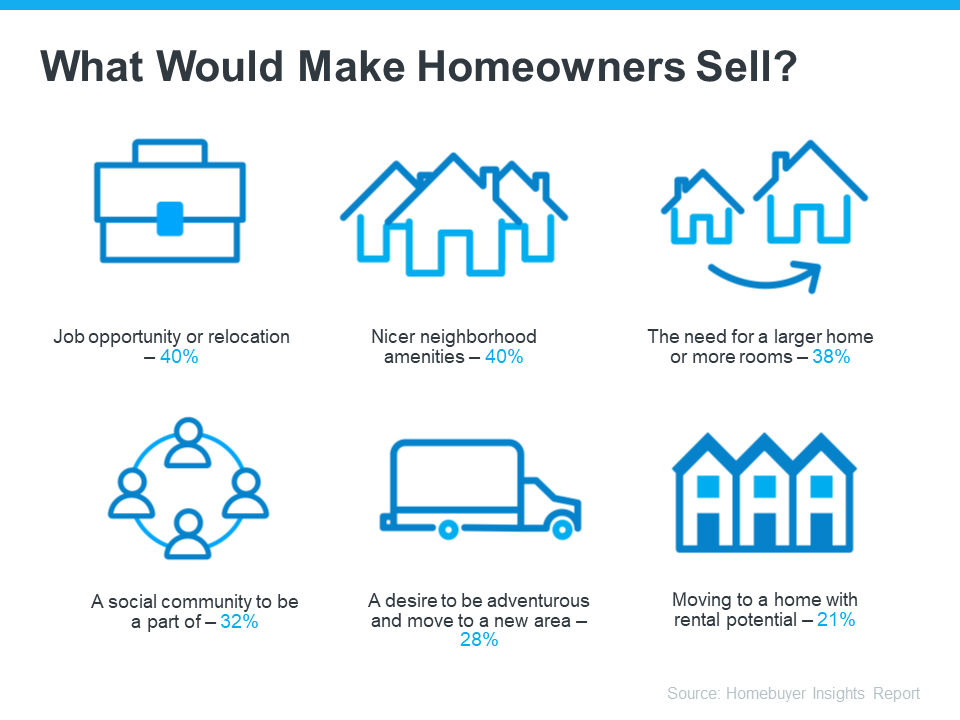
A recent study from Bank of America sheds light on some of the things homeowners say would make them sell, even with rates where they are right now (see visual below):
What Would Motivate You To Move?
Now that you know why other people would move, take a minute to think about what would make a move worth it for you. Is it time to take a chance and go for your dream job, even though it’s not local? Are you looking for a neighborhood with more to offer and a close-knit sense of community? Maybe you need more space, you’re looking for your next great adventure, or you want a condo or house that opens up rental opportunities to pad your income.
And here’s something else to consider. Mortgage rates are still expected to go down over the course of the year. Once that happens, there will be a big rush of buyers jumping back into the market. While you could delay your plans until rates drop, you’ll only have more competition with those buyers if you do.
So, does that mean it’s worth moving now, even with rates where they are? The answer is: that it depends.
You’ll want to consider today’s mortgage rates, where they’re expected to go from here, and what would prompt you to want to make a change as you decide on your next steps. An expert can help with that.
Bottom Line
Other homeowners are getting used to rates and deciding to move. Let’s chat about what matters most and if it’s time for you to jump back into the market too. Contact us today at 734-761-3060 or info@condohotline.com and let’s discuss your options! Check out some different Ann Arbor condo communities here!
Are Higher Mortgage Rates Here To Stay?
Higher Mortgage Rates Are Affecting Purchase Power

Mortgage rates have been back on the rise recently and that’s getting a lot of attention from the press. If you’ve been following the headlines, you may have even seen rates recently reached their highest level in over two decades (see graph below):

That can feel like a little bit of a gut punch if you’re thinking about making a move. If you’re wondering whether or not you should delay your plans, here’s what you really need to know.
How Higher Mortgage Rates Impact You
There’s no denying rates are higher right now than they were in recent years. And, when rates are up, that affects overall home affordability. It works like this. The higher the rate, the more expensive it is to borrow money when you buy a home. That’s because, as rates trend up, your monthly mortgage payment for your future home loan also increases.
Urban Institute explains how this is impacting buyers and sellers right now:
“When mortgage rates go up, monthly housing payments on new purchases also increase. For potential buyers, increased monthly payments can reduce the share of available affordable homes . . . Additionally, higher interest rates mean fewer homes on the market, as existing homeowners have an incentive to hold on to their home to keep their low interest rate.”
Basically, some people are deciding to put their plans on hold because of where mortgage rates are right now. But what you want to know is: is that a good strategy?
Where Will Mortgage Rates Go From Here?
If you’re eager for rates to drop, you’re not alone. A lot of people are waiting for that to happen. But here’s the thing. No one knows when it will. Even the experts can’t say with certainty what’s going to happen next.
Forecasts project rates will fall in the months ahead, but what the latest data says is that rates have been climbing lately. This disconnect shows just how tricky mortgage rates are to project.
The best advice for your move is this: don’t try to control what you can’t control. This includes trying to time the market or guess what the future holds for mortgage rates. As CBS News states:
“If you’re in the market for a new home, experts typically recommend focusing your search on the right home purchase — not the interest rate environment.”
Instead, work on building a team of skilled professionals, including a trusted lender and real estate agent, who can explain what’s happening in the market and what it means for you. If you need to move because you’re changing jobs, want to be closer to family, or are in the middle of another big life change, the right team can help you achieve your goal, even now.
Bottom Line
The best advice for your move is: don’t try to control what you can’t control – especially mortgage rates. Even the experts can’t say for certain where they’ll go from here. Instead, focus on building a team of trusted professionals who can keep you informed. When you’re ready to get the process started, let’s connect today at 734-761-3060 or info@condohotline.com.
What Home Buyers Need to Know About Credit Scores
Credit Scores are a Big Piece of the Lending Puzzle
If you’re thinking about buying a condo or home, you should know your credit score’s a critical piece of the puzzle when it comes to qualifying for a loan. Lenders review your credit to assess your ability to make payments on time, pay back debts, and more. It’s also a factor that helps determine your mortgage rate. An article from Bankrate explains:
“Your credit score is one of the most important factors lenders consider when you apply for a mortgage. Not just to qualify for the loan itself, but for the conditions: Typically, the higher your score, the lower the interest rates and better terms you’ll qualify for.”
This means your credit score may feel even more important to your homebuying plans right now since mortgage rates are a key factor in affordability, especially today. According to the Federal Reserve Bank of New York, the median credit score in the U.S. for those taking out a mortgage is 765. But, that doesn’t mean your credit score has to be perfect. An article from Business Insider explains generally how your FICO score range can make an impact:
“. . . you don’t need a perfect credit score to buy a house. . . . Aiming to get your credit score in the ‘Good’ range (670 to 739) would be a great start towards qualifying for a mortgage. But if you’re wanting to qualify for the lowest rates, try to get your score within the ‘Very Good’ range (740 to 799).”
Working with a trusted lender’s the best way to get more information on how your credit score could factor into your home loan and the mortgage rate you’re able to get. As FICO says:
“While many lenders use credit scores like FICO Scores to help them make lending decisions, each lender has its own strategy, including the level of risk it finds acceptable. There is no single “cutoff score” used by all lenders and there are many additional factors that lenders may use to determine your actual interest rates.”
If you’re looking for ways to improve your score, Experian highlights some things you may want to focus on:
- Your Payment History: Late payments can have a negative impact by dropping your score. Focus on making payments on time and paying any existing late charges quickly.
- Your Debt Amount (relative to your credit limits): When it comes to your available credit amount, the less you’re using, the better. Focus on keeping this number as low as possible.
- Credit Applications: If you’re looking to buy, don’t apply for other credit. When you apply for new credit, it could result in a hard inquiry on your credit that drops your score.
When you’re ready to start the homebuying process, a lender will be able to assess which range your score falls in and tell you more about the specifics for each loan type.
Bottom Line
With affordability challenges today, prioritizing ways you can have a positive impact on your credit score could help you get a better mortgage rate. To learn more, let’s connect today at 734-761-3060 or info@condohotline.com.
Pre-Approval in 2023: What You Need To Know
Pre-Approval in 2023: What You Need To Know

One of the first steps in your condo or home-buying journey is getting pre-approved. To understand why it’s such an important step, you need to understand what pre-approval is and what it does for you. Business Insider explains:
“In a preapproval [sic], the lender tells you which types of loans you may be eligible to take out, how much you may be approved to borrow, and what your rate could be.”
Basically, pre-approval gives you critical information about the buying process that’ll help you understand your options and what you may be able to borrow.
How does it work? As part of the pre-approval process, a lender will look at your finances to determine what they’d be willing to loan you. From there, your lender will give you a pre-approval letter to help you understand how much money you can borrow. That can make it easier when you set out to search for condos or homes because you’ll know your overall numbers. And with higher mortgage rates impacting affordability for many buyers today, a solid understanding of your numbers is even more important.
Pre-Approval Helps Show You’re a Serious Buyer
Another added benefit is pre-approval can help a seller feel more confident in your offer because it shows you’re serious about buying their property. A recent article from Forbes notes:
“From the seller’s perspective, a preapproval [sic] letter from a reputable local lender often can make the difference between accepting and rejecting an offer.”
This goes to show, even though you may not face the intense bidding wars you saw if you tried to buy during the pandemic, pre-approval is still an important part of making a strong offer. In fact, Christy Bieber, Personal Finance Writer at The Motley Fool explains it may be the most important part of making an offer:
“Pre-approval maximizes the chances you’ll be able to actually close the deal – and sellers want to see that.
The fact that a pre-approval gives you a better chance of getting your offer accepted is undoubtedly the most important reason to complete this step . . .”
Bottom Line
Getting pre-approved is an important first step toward buying a condo or home. It lets you know what you can borrow and shows sellers you’re serious about purchasing their condo or home. Connect with a local real estate professional and a trusted lender so you have the tools you need to purchase in today’s market. Contact us at 734-761-3060 or info@condohotline.com to discuss your path to ownership!
Mortgage Rates Are Dropping. What Does That Mean for You?
Mortgage Rates Are Dropping. What Does That Mean for You?

Mortgage rates have been a hot topic in the housing market over the past 12 months. Compared to the beginning of 2022, rates have risen dramatically. Now they’re dropping, and that has to do with everything happening in the economy.
Nadia Evangelou, Senior Economist and Director of Forecasting at the National Association of Realtors (NAR), explains it well by saying:
“Mortgage rates dropped even further this week as two main factors affecting today’s mortgage market became more favorable. Inflation continued to ease while the Federal Reserve switched to a smaller interest rate hike. As a result, according to Freddie Mac, the 30-year fixed mortgage rate fell to 6.31% from 6.33% the previous week.”
So, what does that mean for your homeownership plans? As mortgage rates fluctuate, they impact your purchasing power by influencing the cost of buying a home. Even a small dip can help boost your purchasing power. Here’s how it works.
The median-priced home according to the National Association of Realtors (NAR) is $379,100. So, let’s assume you want to buy a $400,000 home. If you’re trying to shop at that price point and keep your monthly payment about $2,500-2,600 or below, here’s how your purchasing power can change as mortgage rates move up or down (see chart below). The red shows payments above that threshold and the green indicates a payment within your target range.
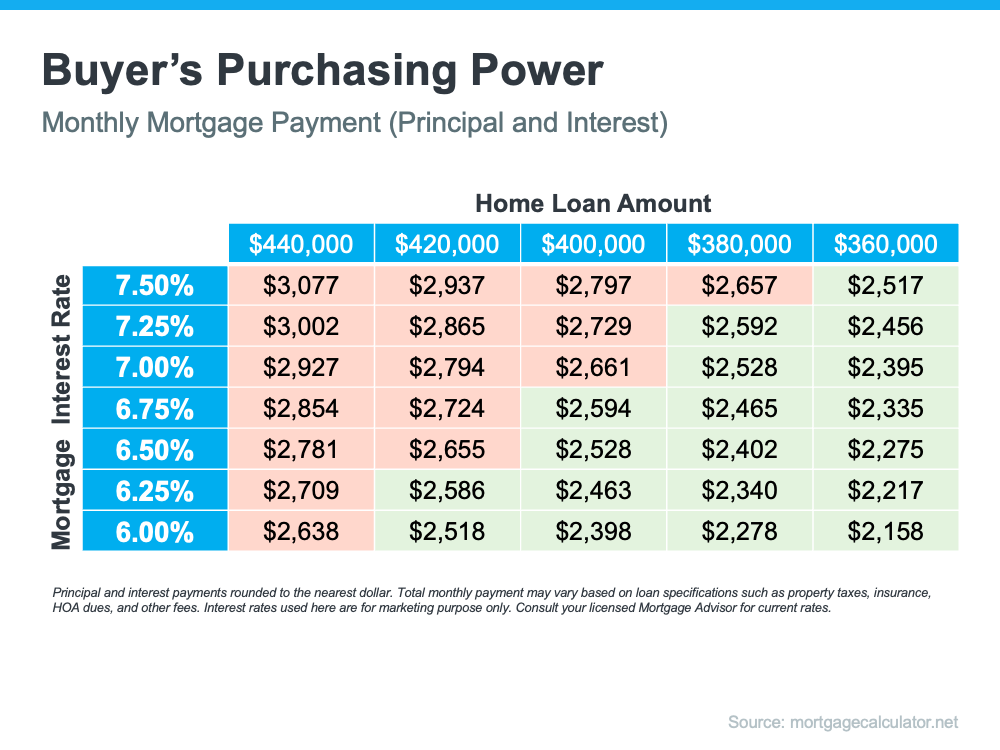
This goes to show, even a small quarter-point change in mortgage rates can impact your monthly mortgage payment. That’s why it’s important to work with a trusted real estate professional who follows what the experts are projecting for mortgage rates for the days, months, and year ahead.
Bottom Line
Mortgage rates are likely to fluctuate depending on what happens with inflation moving forward, but they have dropped slightly in recent weeks. If a 7% rate was too high for you, it may be time to contact a lender to see if the current rate is more in line with your goal for a monthly housing expense. Contact us today at 734-761-3060 to discuss your condo or home-owning plans and let our team of specialists help you achieve them! 734-761-3060 or info@condohotline.com.
Four Things That Help Determine Your Mortgage Rate

Four Things That Help Determine Your Mortgage Rate
If you’re looking to buy a condo or a home, you probably want to secure the lowest interest rate possible for your mortgage loan. Over the last couple of years, that was easier to do as the housing market saw record-low mortgage rates, but this year rates have risen dramatically.
If you’re looking for ways to combat today’s higher rates and lock in the lowest one you can, here are a few factors to focus on. Since approval opportunities can vary, connect with a trusted lender for customized advice.
Your Credit Score
Credit scores can play a big role in your mortgage rate. Freddie Mac explains:
“When you build and maintain strong credit, mortgage lenders have greater confidence when qualifying you for a mortgage because they see that you’ve paid back your loans as agreed and used your credit wisely. Strong credit also means your lender is more apt to approve you for a mortgage that has more favorable terms and a lower interest rate.”
That’s why it’s important to maintain a good credit score. If you want to focus on improving your score, your trusted advisor can give you expert advice to help.
Your Loan Type
There are many types of loans, each offering different terms for qualified buyers. The Consumer Financial Protection Bureau (CFPB) says:
“There are several broad categories of mortgage loans, such as conventional, FHA, USDA, and VA loans. Lenders decide which products to offer, and loan types have different eligibility requirements. Rates can be significantly different depending on what loan type you choose.”
When working with your real estate advisor, make sure you find out what’s available in your area and which types of loans you may qualify for.
Your Loan Term
Another factor to consider is the term of your loan. Just like with location and loan types, you have options. Freddie Mac says:
“When choosing the right home loan for you, it’s important to consider the loan term, which is the length of time it will take you to repay your loan before you fully own your home. Your loan term will affect your interest rate, monthly payment, and the total amount of interest you will pay over the life of the loan.”
Depending on your situation, the length of your loan can also change your mortgage rate.
Your Down Payment
If you’re a current homeowner looking to sell and make a move, you can use the home equity you’ve built over time toward the down payment on your next home. The CFPB explains:
“In general, a larger down payment means a lower interest rate, because lenders see a lower level of risk when you have more stake in the property. So if you can comfortably put 20 percent or more down, do it—you’ll usually get a lower interest rate.”
To learn more, connect with a lender to find out the difference a higher down payment can make for your new mortgage. We have a terrific list of local lenders, just ask us!
Bottom Line
These are just a few factors that can help determine your mortgage rate if you’re buying a condo or home. The best thing you can do is have a team of professionals on your side. Connect with us, The Bouma Group, your local real estate professionals, and a trusted lender so you have the expert advice you need at each step of the process. Contact us today at 734-761-3060 or info@condohotline.com.
3 Graphs To Show This Isn’t a Housing Bubble

With all the headlines and buzz in the media, some consumers believe the market is in a housing bubble. As the housing market shifts, you may be wondering what’ll happen next. It’s only natural for concerns to creep in that it could be a repeat of what took place in 2008. The good news is, there’s concrete data to show why this is nothing like the last time.
There’s a Shortage of Homes on the Market Today, Not a Surplus
The supply of inventory needed to sustain a normal real estate market is approximately six months. Anything more than that is an overabundance and will causes prices to depreciate. Anything less than that is a shortage and will lead to continued price appreciation.
For historical context, there were too many homes for sale during the housing crisis (many of which were short sales and foreclosures), and that caused prices to tumble. Today, supply is growing, but there’s still a shortage of inventory available.
The graph below uses data from the National Association of Realtors (NAR) to show how this time compares to the crash. Today, unsold inventory sits at just a 3.0-months supply at the current sales pace.
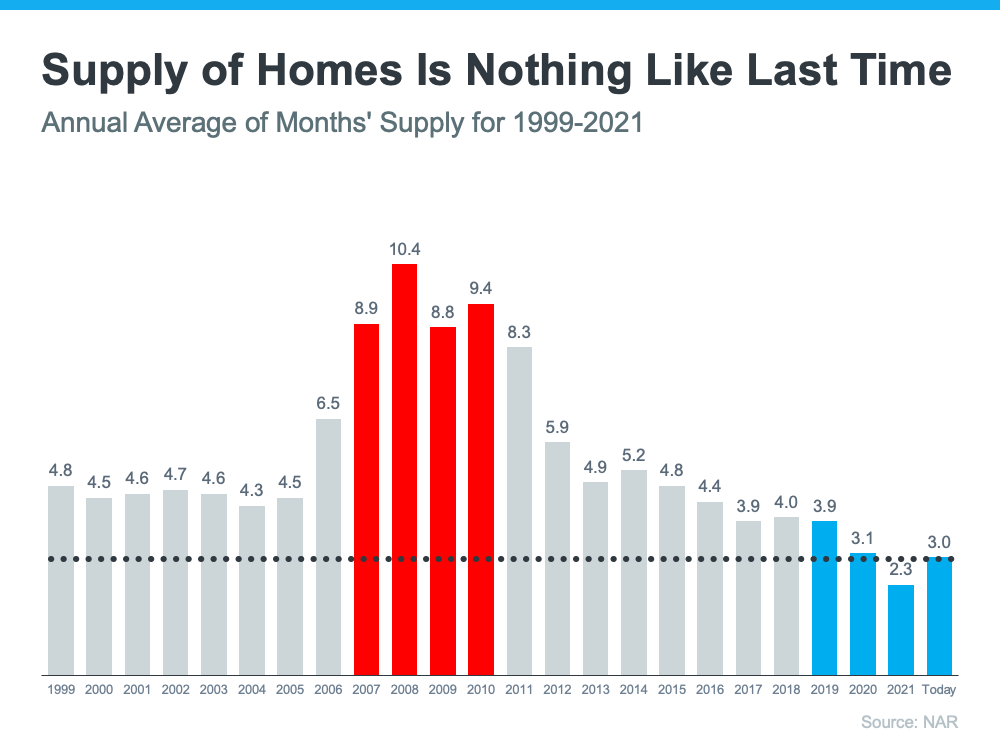
One of the reasons inventory is still low is because of sustained underbuilding. When you couple that with ongoing buyer demand as millennials age into their peak homebuying years, it continues to put upward pressure on home prices. That limited supply compared to buyer demand is why experts forecast home prices won’t fall this time.
Mortgage Standards Were Much More Relaxed During the Crash
During the lead-up to the housing crisis, it was much easier to get a home loan than it is today. The graph below showcases data on the Mortgage Credit Availability Index (MCAI) from the Mortgage Bankers Association (MBA). The higher the number, the easier it is to get a mortgage.
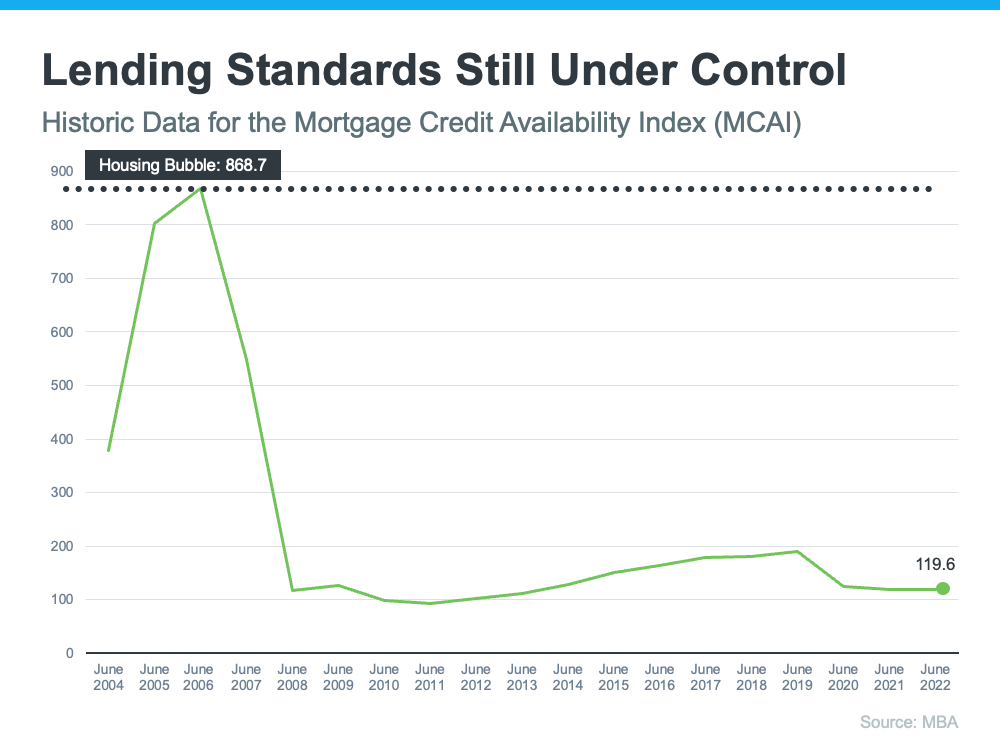
Running up to 2006, banks were creating artificial demand by lowering lending standards and making it easy for just about anyone to qualify for a home loan or refinance their current home. Back then, lending institutions took on much greater risk in both the person and the mortgage products offered. That led to mass defaults, foreclosures, and falling prices.
Today, things are different, and purchasers face much higher standards from mortgage companies. Mark Fleming, Chief Economist at First American, says:
“Credit standards tightened in recent months due to increasing economic uncertainty and monetary policy tightening.”
Stricter standards, like there are today, help prevent a risk of a rash of foreclosures like there was last time.
The Foreclosure Volume Is Nothing Like It Was During the Crash
The most obvious difference is the number of homeowners that were facing foreclosure after the housing bubble burst. Foreclosure activity has been on the way down since the crash because buyers today are more qualified and less likely to default on their loans. The graph below uses data from ATTOM Data Solutions to help tell the story:
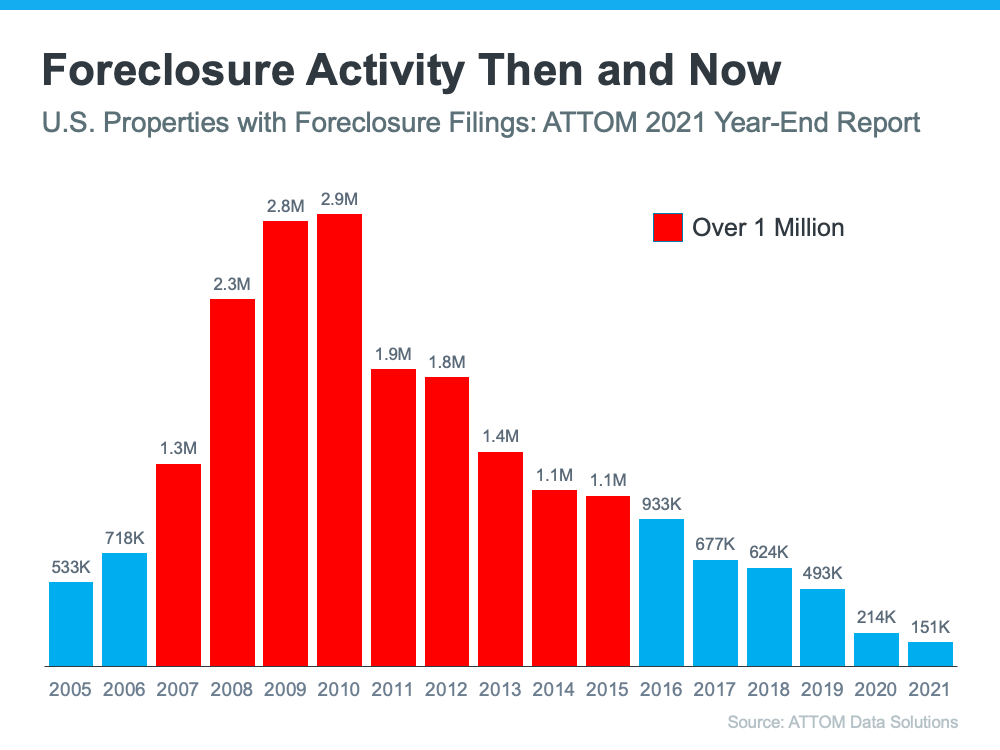
In addition, homeowners today are equity rich, not tapped out. In the run-up to the housing bubble, some homeowners were using their homes as personal ATMs. Many immediately withdrew their equity once it built up. When home values began to fall, some homeowners found themselves in a negative equity situation where the amount they owed on their mortgage was greater than the value of their home. Some of those households decided to walk away from their homes, and that led to a wave of distressed property listings (foreclosures and short sales), which sold at considerable discounts that lowered the value of other homes in the area.
Today, prices have risen nicely over the last few years, and that’s given homeowners an equity boost. According to Black Knight:
“In total, mortgage holders gained $2.8 trillion in tappable equity over the past 12 months – a 34% increase that equates to more than $207,000 in equity available per borrower. . . .”
With the average home equity now standing at $207,000, homeowners are in a completely different position this time.
Bottom Line
If you’re worried we’re making the same mistakes that led to the housing crash, the graphs above should help alleviate your concerns. Concrete data and expert insights clearly show why this is nothing like the last time. We study the real estate market every single day, so give us a call today at 734-761-3060 to talk about your particular condo or home buying or selling goals in today’s market at 734-761-3060 or email info@condohotline.com.